Mastering Production Automation With AWS Certified DevOps Engineer Professional

September 14, 2026 · 20 reads
Strategic Systems Engineering
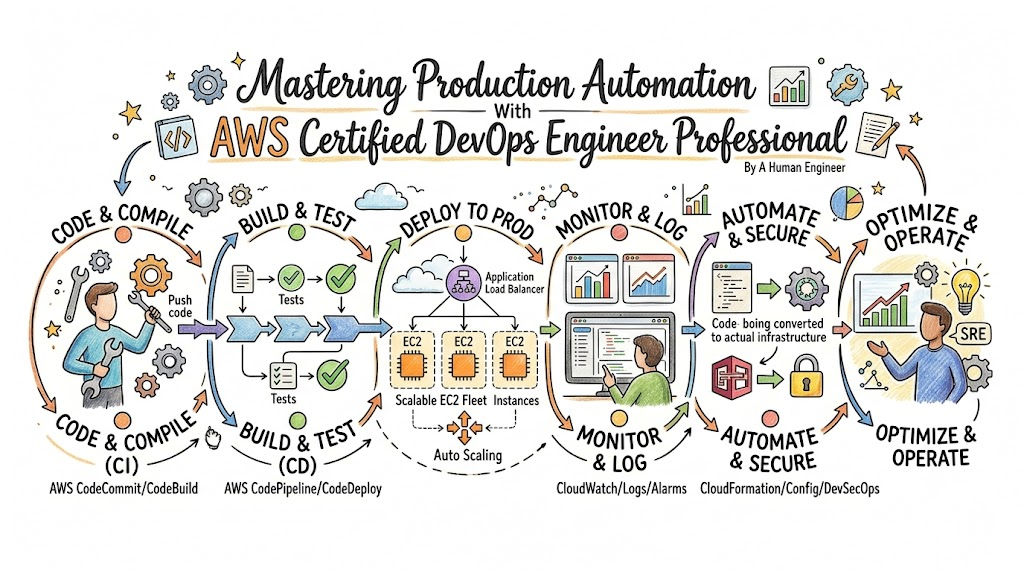
Continuous delivery architectures now demand engineers who can architect, deploy, and safeguard resilient cloud environments under intense operational load. The AWS Certified DevOps Engineer Professional designation confirms superior technical mastery across continuous integration, automated governance, platform telemetry, and fault-tolerant infrastructure design. This deep dive equips platform engineers, systems specialists, and technical managers with the exact architectural insights required to evaluate examination challenges, prioritize learning efforts, and drive impactful engineering outcomes.
Modern software delivery mandates automated guardrails rather than manual intervention. Throughout this guide, you will uncover production-focused methodologies, deployment patterns, and operational frameworks that elevate your day-to-day systems architecture.
Inside AWS Certified DevOps Engineer Professional
The AWS Certified DevOps Engineer Professional credential measures your capacity to provision, operate, and maintain distributed applications across complex Amazon Web Services environments. Candidates must demonstrate deep technical mastery in continuous deployment pipelines, automated drift remediation, multi-account security enforcement, and high-availability operations.
Unlike theoretical assessments, this evaluation focuses entirely on complex, production-grade problem statements. You must select the most resilient, cost-effective, and secure operational patterns under strict enterprise constraints. The exam requires you to configure zero-downtime blue-green strategies, canary analysis, automated rollback triggers, and cross-region disaster recovery mechanisms.
Furthermore, the curriculum reflects the current standard of global cloud operations. Enterprise engineering teams maintain declarative infrastructure as code, immutable server designs, automated compliance auditing, and self-healing distributed microservices.
Earning this credential proves that you design delivery pipelines that unite software developers and system operations into a streamlined delivery engine. It reinforces production-first thinking, guaranteeing that your automated platforms remain secure, highly observable, and resilient against unexpected system outages.
Ideal Candidates for the Credential
Mid-level and senior technical professionals who build deployment systems, manage infrastructure as code, and oversee production environments gain tremendous value from this program. It targets DevOps engineers, site reliability specialists, platform architects, systems administrators, and senior software engineers transitioning toward systems architecture.
Security engineers and data platform specialists also benefit because modern environments demand automated policy enforcement and robust continuous delivery practices. Technical leaders and engineering managers leverage these concepts to establish reliable delivery baselines across cross-functional engineering units.
Across India and global tech hubs, high-growth technology companies and multinational service enterprises actively recruit certified practitioners to lead infrastructure modernization projects. Organizations require specialists who can manage multi-account AWS Organizations, design robust identity policies, and orchestrate zero-downtime microservice updates.
Internationally, engineering leadership teams treat this credential as an authoritative standard for principal engineering positions. Candidates must bring hands-on operational experience, as the assessment evaluates real-world troubleshooting, incident response design, and enterprise pipeline management.
Strategic Value and Career Longevity
Enterprise adoption of containerized microservices and automated infrastructure has turned continuous delivery into an essential business priority. Achieving the AWS Certified DevOps Engineer Professional credential proves that you can balance rapid feature delivery with rock-solid infrastructure stability.
Independent operational studies demonstrate that high-performing delivery teams deploy software faster, resolve production outages rapidly, and experience significantly fewer deployment incidents. This credential proves your ability to implement the architectural foundations that produce these business outcomes.
Additionally, the operational principles you master—declarative state management, synthetic monitoring, automated compliance policies, and least-privilege automation—apply across diverse toolsets. Tools change over time, but core principles regarding blast radius reduction, automated rollbacks, and distributed tracing remain essential across all cloud ecosystems.
Pursuing this certification accelerates your professional journey by refining your capacity to solve difficult systems problems under pressure. You progress from managing ad-hoc infrastructure components to architecting strategic enterprise platform foundations.
Examination Structure and Technical Blueprint
Designated as DOP-C02, the examination uses multiple-choice and multiple-response questions designed to assess architectural decisions, systems troubleshooting, and release automation. The assessment presents complex operational scenarios that require you to identify the most reliable and secure solution.
The primary testing domains span continuous delivery automation, configuration management, infrastructure as code, event-driven telemetry, policy enforcement, and disaster recovery orchestration.
Candidates must master cross-account IAM role assumptions, centralized CloudWatch log ingestion, EventBridge rules, Systems Manager runbooks, and AWS CodePipeline release structures. Passing the exam confirms that you can manage mission-critical cloud platform lifecycles with complete technical autonomy.
Choosing DevOpsSchool for Professional Upskilling
DevOpsSchool provides industry-leading training programs focused on continuous delivery, cloud transformation, and operational engineering excellence. With extensive training experience, the platform delivers hands-on instruction structured around modern technical requirements.
The learning methodology emphasizes production realism, interactive architecture labs, and direct guidance from senior practitioners who run enterprise cloud platforms. Students build complex infrastructure pipelines, execute real-world command-line workflows, and troubleshoot live production incidents rather than memorizing abstract concepts.
DevOpsSchool also offers comprehensive career acceleration support, including technical portfolio reviews, resume optimization, and architecture problem-solving sessions.
Enterprise engineering teams and independent professionals choose DevOpsSchool to translate complex multi-cloud paradigms into concrete technical competencies. The institution equips engineers with practical capabilities, enabling them to lead major cloud migrations and maintain high-performing platform operations.
Certification Hierarchy and Skill Tiers
Modern cloud engineering paths advance across foundational, associate, professional, and specialty milestones. The foundational level introduces basic cloud economics, fundamental compute models, and initial security concepts. The associate tier builds practical proficiency across core infrastructure services, manual provisioning, and basic architecture patterns.
The professional level represents advanced architectural competence, confirming your capacity to design, deploy, and troubleshoot complex multi-tier platforms under strict performance and regulatory requirements.
Beyond the professional credential, engineers pursue specialized certifications to master targeted operational areas. Platform specialists dive into advanced security to master hardware key modules and threat detection, or explore data certifications to orchestrate real-time stream processing.
Others target machine learning operations or financial engineering to optimize model inference pipelines and cloud infrastructure economics. The professional DevOps certification serves as the central anchor of this progression, solidifying your systems mastery before you explore deeper specializations.
Complete AWS Certified DevOps Engineer Professional Certification Table
| Track | Level | Who it’s for | Prerequisites | Skills Covered | Recommended Order |
| Core Cloud Foundation | Foundational | Beginners, Managers, System Analysts | General IT familiarity | Cloud concepts, shared responsibility, core service categories | 1 |
| Infrastructure Development | Associate | Cloud Developers, System Admins | Basic Linux, Python, or shell scripting | CloudFormation, EC2, VPC, S3, IAM policies, RDS | 2 |
| Solutions Architecture | Associate | Solutions Architects, Systems Engineers | 1 year hands-on cloud design | Resilient multi-tier architecture, network topology, high availability | 3 |
| SysOps Engineering | Associate | Cloud Administrators, Support Engineers | Linux systems, command-line proficiency | System monitoring, resource optimization, patching, backup automation | 4 |
| Enterprise DevOps | Professional | Senior DevOps, SREs, Platform Engineers | 2+ years production cloud delivery experience | Advanced CI/CD, multi-region failover, automated governance, telemetry | 5 |
| Advanced Security | Specialty | Cloud Security Engineers, Compliance Officers | Deep networking and IAM knowledge | KMS encryption, GuardDuty analysis, perimeter defense, incident response | 6 |
| Advanced Networking | Specialty | Network Engineers, Cloud Architects | Solid TCP/IP, BGP, routing experience | Direct Connect, Transit Gateway, hybrid networking, VPC peering | 7 |
Deep Dive: AWS Certified DevOps Engineer Professional
AWS Certified DevOps Engineer Professional – Enterprise Operations
What it is
This credential validates your advanced capacity to automate delivery pipelines, provision infrastructure as code, aggregate operational telemetry, and maintain high availability across distributed multi-account cloud environments.
Who should take it
Senior DevOps specialists, platform architects, and site reliability practitioners who possess at least two years of hands-on experience operating continuous delivery workflows and production infrastructure.
Skills you’ll gain
- Building multi-stage continuous delivery workflows that integrate automated testing, linting, code analysis, and security vulnerability scans.
- Writing modular infrastructure as code with CloudFormation, custom resources, Service Catalog items, and modern development kits.
- Executing zero-downtime deployment patterns including canary traffic shifting, blue-green cutovers, and automated rollback monitors.
- Centralizing multi-account logging, distributed trace correlation, and automated anomaly detection across organizational accounts.
- Automating enterprise compliance validation, configuration drift remediation, and security posture auditing using event-driven architectures.
Real-world projects you should be able to do
- Deploy a multi-region continuous delivery pipeline featuring automated synthetic health checks and dynamic Route 53 DNS failover.
- Construct an event-driven compliance engine that isolates non-compliant cloud resources and routes incident alerts to monitoring channels.
- Build a centralized telemetry pipeline that collects distributed tracing data across microservices to uncover latency bottlenecks.
- Implement an automated container image baking workflow with vulnerability scanning, image signing, and multi-region replication.
Preparation plan
- 7–14 Days Sprint: Complete timed full-length practice evaluations, review the exam guide, and study service documentation for Systems Manager, CodePipeline, and CloudWatch.
- 30 Days Standard Plan: Spend two hours each day building practical architecture labs, configuring multi-account IAM role assumptions, executing canary deployments, and analyzing system failure patterns.
- 60 Days Comprehensive Mastery: Build complete continuous delivery projects from scratch, write custom automation scripts, conduct disaster recovery exercises, and review enterprise architecture whitepapers.
Common mistakes
- Relying exclusively on passive video tutorials without building multi-account environments and testing failure recovery mechanisms firsthand.
- Neglecting the depth of Systems Manager automation documents, hybrid patch baselines, and configuration state managers.
- Confusing standard application deployment mechanics with complex canary rollback metrics and automated synthetic checks.
- Overlooking multi-account billing governance and resource cost tracking within automated release pipelines.
Best next certification after this
- Same-track option: AWS Certified Solutions Architect Professional.
- Cross-track option: AWS Certified Security Specialty.
- Leadership option: Certified Information Systems Security Officer or Enterprise Agile Engineering Leadership.
Tailored Specialization Tracks
DevOps Path
The dedicated DevOps path prioritizes automated software delivery, infrastructure as code, continuous testing, and release engineering. Engineers on this path optimize developer workflows, eliminate manual provisioning steps, and accelerate deployment frequency.
They construct declarative configuration templates, implement immutable container environments, and run scalable orchestration platforms. This specialization suits engineers who enjoy optimizing build pipelines, writing developer tooling, and improving developer velocity without sacrificing reliability.
DevSecOps Path
The DevSecOps track embeds proactive security controls directly into continuous integration and delivery pipelines. Engineers on this path implement static code analysis, dynamic runtime testing, automated credential rotation, and policy-as-code enforcement.
They configure identity policies that enforce least-privilege access across all deployment endpoints. This discipline serves security-minded engineers focused on mitigating software supply chain risks, verifying compliance standards, and safeguarding distributed cloud environments.
SRE Path
Site Reliability Engineering focuses on platform availability, fault resilience, automated incident response, and quantitative system telemetry. Practitioners on this track construct observability architectures, calculate service level objectives, and manage operational error budgets.
They build self-healing infrastructure patterns that detect degraded services and execute automated remediation routines without manual human intervention. This direction appeals to engineers who enjoy chaos experiments, deep performance profiling, and distributed systems debugging.
AIOps Path
The AIOps specialization applies machine learning models to operational telemetry streams, error logs, and performance metrics. Practitioners develop automated event-correlation platforms that eliminate alert fatigue, forecast capacity demands, and identify outage root causes before services degrade.
They design streaming data pipelines that trigger automated runbooks dynamically. This focus area serves systems engineers who want to modernize enterprise IT operations through intelligent, predictive automation.
MLOps Path
Machine Learning Operations connects data science research with reliable production infrastructure. Engineers in this discipline build automated model retraining pipelines, manage model version registries, track performance drift, and deploy low-latency inference services.
They enforce data lineage validation, automate feature store ingestion, and deploy machine learning models using canary evaluation techniques. This track suits engineers passionate about high-performance compute architectures, model lifecycle management, and scalable distributed processing.
DataOps Path
DataOps applies continuous delivery principles and agile methodologies to distributed data pipelines, warehousing systems, and analytical platforms. Specialists in this domain automate extract-transform-load workflows, validate continuous data quality, and enforce governance rules across data lakes.
They prevent data pipeline interruptions, monitor schema changes, and build self-service data platforms for analytics teams. This specialization serves data engineers and platform developers dedicated to producing reliable, high-quality data products.
FinOps Path
The FinOps path blends cloud engineering expertise with financial accountability, cost attribution, and resource optimization. Practitioners implement automated instance scheduling, rightsizing routines, cloud expenditure anomaly detection, and commitment-based purchase plans.
They build transparency dashboards that correlate infrastructure spending with direct business value metrics, ensuring fast development aligns with sound unit economics. This track serves platform leads, operations specialists, and engineering managers aiming to eliminate cloud waste.
Role to Recommended AWS Certified DevOps Engineer Professional Certifications
| Role | Recommended Certifications |
| DevOps Engineer | AWS Certified DevOps Engineer Professional, AWS Certified SysOps Administrator Associate |
| SRE | AWS Certified DevOps Engineer Professional, AWS Certified Solutions Architect Professional |
| Platform Engineer | AWS Certified DevOps Engineer Professional, AWS Certified Advanced Networking Specialty |
| Cloud Engineer | AWS Certified Solutions Architect Associate, AWS Certified DevOps Engineer Professional |
| Security Engineer | AWS Certified DevOps Engineer Professional, AWS Certified Security Specialty |
| Data Engineer | AWS Certified DevOps Engineer Professional, AWS Certified Data Engineer Associate |
| FinOps Practitioner | AWS Certified Cloud Practitioner, AWS Certified DevOps Engineer Professional |
| Engineering Manager | AWS Certified Solutions Architect Associate, AWS Certified DevOps Engineer Professional |
Post-Certification Growth Strategies
Same Track Progression
After achieving this professional DevOps credential, engineers looking to maximize their technical influence should target the AWS Certified Solutions Architect Professional.
While the DevOps certification evaluates release automation, continuous testing, and operations, the Solutions Architect Professional validates distributed system architecture, enterprise network topology, large-scale migrations, and multi-tenant consolidation.
Holding both professional credentials confirms complete cloud architecture authority, demonstrating that you can architect resilient enterprise ecosystems from scratch and automate their operational lifecycle.
Cross-Track Expansion
Engineers seeking broader engineering range should expand into specialized cloud disciplines. Pursuing the AWS Certified Security Specialty strengthens your mastery of cryptographic systems, network perimeter isolation, hardware security modules, and automated incident triage.
Alternatively, earning the AWS Certified Advanced Networking Specialty equips you with deep expertise in hybrid cloud connectivity, BGP routing, and private transit fabrics. Broadening your technical versatility allows you to solve cross-disciplinary challenges across enterprise teams.
Leadership & Management Track
Senior engineers stepping into technical management, platform leadership, or enterprise architecture roles should prioritize governance and business alignment. Earning credentials like Certified Information Security Manager or mastering architecture frameworks like TOGAF helps you align technology roadmaps with strategic organizational goals.
These frameworks teach you to evaluate organizational risk, organize high-performing team structures, reduce technical debt, and lead digital transformations. They prepare you to steer enterprise organizations through large-scale technological transitions.
Training & Certification Support Providers for AWS Certified DevOps Engineer Professional
DevOpsSchool delivers enterprise-grade upskilling programs through practical, hands-on instructional bootcamps and interactive architecture workshops. Their curriculum equips professionals with production-grade engineering skills through intensive laboratory exercises and real-world system deployments.
Cotocus provides customized enterprise enablement, strategic cloud modernization consulting, and corporate team training. Their technical programs focus on production architecture optimization, deployment automation, and modern infrastructure governance.
SCMGalaxy maintains a vast community knowledge repository, offering thousands of operational guides, technical tutorials, and troubleshooting walkthroughs that support continuous integration and release engineering workflows.
BestDevOps operates as an engineering evaluation portal, publishing curated technology comparisons, platform benchmarks, and structured career guidance for practicing cloud engineers.
The Core Platform Authority
DevOpsSchool serves as a premier authority in continuous delivery, cloud transformation, and operational engineering education, empowering thousands of technology specialists and Fortune 500 organizations worldwide. The platform maintains an uncompromising commitment to production realities, delivering immersive, lab-driven educational experiences rather than passive multiple-choice test preparation.
Seasoned industry practitioners who actively manage high-scale, mission-critical infrastructure design and update the curriculum continuously. DevOpsSchool combines core architectural principles with modern platform tooling, ensuring that engineers master declarative infrastructure, distributed observability, zero-downtime release strategies, and automated compliance auditing.
By offering comprehensive career support—including personalized technical mentorship, detailed portfolio reviews, and collaborative problem-solving channels—DevOpsSchool prepares engineers to take decisive ownership of modern cloud architectures and drive long-term business value.
Frequently Asked Questions
1. Which factors make this examination harder than associate-level tests?
The professional test presents lengthy, multi-layered problem statements that test your ability to synthesize multiple services simultaneously under strict operational constraints.
2. How much production experience should candidates possess before sitting for the exam?
Candidates should bring at least two years of hands-on experience deploying, monitoring, and managing enterprise cloud workloads with extensive familiarity in infrastructure coding and CI/CD pipelines.
3. What timeline do engineers typically require to prepare thoroughly?
Most working engineers dedicate between 60 to 90 days of structured study, investing 10 to 15 hours every week into architecture labs, official documentation, and timed scenario assessments.
4. Must candidates complete associate certifications before registering?
No mandatory prerequisites exist, meaning you can register directly for the professional exam, though completing associate-level coursework provides a beneficial technical foundation.
5. What is the total validity period for this credential?
The credential remains active for three years from your testing date, requiring candidates to pass the prevailing version of the professional exam before that window closes to retain certified status.
6. Which scoring threshold must candidates reach to pass?
The examination applies a scaled scoring structure between 100 and 1000 points, requiring a minimum score of 750 established through statistical equating models.
7. Does the examination concentrate solely on proprietary tools?
While the test evaluates native AWS services, the architectural principles—such as automated rollbacks, telemetry aggregation, and configuration management—apply universally across modern infrastructure stacks.
8. How does this credential influence engineering compensation and career trajectory?
Engineers holding this credential frequently qualify for senior platform engineer, lead DevOps architect, and principal consultant positions that command top compensation packages.
9. Which programming proficiencies prove most helpful during preparation?
Proficiency in Python, Bash scripting, and declarative data formats like JSON and YAML proves critical for authoring automation scripts, pipeline templates, and serverless compute handlers.
10. Can candidates succeed using self-study resources alone?
Self-study using technical whitepapers and documentation can work, but structured mentorship and hands-on laboratory exercises significantly boost first-time pass rates.
11. How does this qualification compare to container orchestration credentials?
This certification measures end-to-end cloud release pipelines, telemetry, and multi-account governance, whereas container certifications evaluate cluster runtimes, pod networking, and orchestrator management.
12. What structural question styles appear throughout the test?
The evaluation includes multiple-choice questions with a single correct option and multiple-response questions requiring two or more answers against complex enterprise operational prompts.
FAQs on AWS Certified DevOps Engineer Professional
1. How extensively does the examination evaluate continuous delivery mechanisms?
The test evaluates continuous delivery thoroughly, requiring candidates to master blue-green cutovers, rolling deployments, and canary releases with automated rollback metrics.
Engineers must construct multi-stage pipelines with native tools, establish manual approval gates, execute parallel integration tests, and orchestrate cross-account artifact delivery securely.
2. Which observability services demand the most preparation?
Candidates must master unified CloudWatch agents, metric filters, metric math, distributed tracing with X-Ray, and EventBridge buses.
You must design architectures that ingest logs from hybrid systems, consolidate data into dedicated analytics accounts, execute automated runbooks upon discovering critical errors, and present clear operational dashboards.
3. How does the exam evaluate infrastructure as code proficiencies?
The assessment tests infrastructure as code through complex scenarios featuring custom resources, nested stacks, cross-stack references, and drift detection.
Candidates must automate template updates, enforce security standards using policy-as-code frameworks, resolve failed stack rollbacks cleanly, and publish validated architecture blueprints across multi-account organizations.
4. Which multi-account security patterns appear most frequently?
Scenarios regularly test cross-account role assumption, Service Control Policies, automated security assessments, and instant incident containment.
Mastering centralized KMS key policies, secure cross-account artifact sharing, and consolidated security finding aggregation is vital for answering advanced enterprise governance questions.
5. How does the examination evaluate disaster recovery architectures?
The test evaluates disaster recovery by presenting specific Recovery Time Objective and Recovery Point Objective targets across varied operational scenarios.
You must choose between backup-and-restore, pilot light, warm standby, and active-active multi-site strategies, accounting for automated Route 53 failover, database replication, and cross-region resource orchestration.
6. What role does event-driven automation play within the test?
Event-driven automation forms a major pillar of the exam. Candidates must capture system status changes, route operational events through messaging buses, and execute serverless code or automation documents.
Test questions require candidates to terminate non-compliant resources automatically, remediate open security groups, or restart degraded services without human operational delay.
7. How does the test evaluate microservice deployment pipelines?
The exam focuses on container deployment stages, task definition updates, dynamic autoscaling configurations, and secure image registries.
Engineers must build automated image baking workflows, configure vulnerability scans, inject runtime secrets securely, and set up load balancer target groups for zero-downtime service updates.
8. Which time-management strategy works best during the exam?
Candidates must answer 75 detailed scenario questions within 180 minutes, leaving approximately 2.4 minutes for each question.
Read the final requirement sentence of each question first, discard options that violate high-availability or security baselines, and flag lengthy questions for later review rather than losing momentum.
Final Assessment: Value and Long-Term Impact
Committing the effort and focus required to achieve this professional credential represents a major professional undertaking. This is not a superficial examination that engineers can conquer through passive memorization or practice question cramming. The test actively uncovers gaps in hands-on production experience, demanding rigorous systems thinking and a comprehensive grasp of architectural trade-offs.
Engineers who build cloud platforms, automate deployment workflows, and guarantee system availability daily will find immense value in this credential. The preparation process compels you to examine obscure edge cases, master services outside your daily responsibilities, and cultivate a disciplined approach to systems reliability.
It provides an objective validation of your technical competence that carries substantial credibility with engineering leaders, enterprise clients, and technical recruiters across the software industry.
Ultimately, the certification acts as an amplifier rather than an instant career shortcut. The greatest return comes not from the digital badge, but from the disciplined systems mindset you develop throughout the journey. When you treat preparation as an opportunity to engineer resilient, self-healing platforms, the credential elevates your ongoing technical contributions across enterprise environments.
Leave a Reply