Master Modern Cloud Delivery and High Availability Infrastructure Workflows

September 10, 2026 · 22 reads
Introduction
Rapid technological shifts compel software companies to accelerate their application delivery cycles. Because manual server management slows engineering output, organizations actively replace fragmented workflows with high-velocity deployment pipelines.
Modern infrastructure practices unite software developers with system operations staff. Through rigorous automation, clear operational standards, and active pipeline optimization, cross-functional engineering teams ship reliable digital products to production without unplanned downtime.
What Is DevOps and Why Does It Matter Today?
Engineers define DevOps as an operational philosophy that fuses software construction with rapid system delivery. Earlier development models forced programmers to write code in isolation while sysadmins handled deployment tasks separately, generating recurrent release failures and workplace friction.
Enterprises now demand continuous uptime alongside hourly feature releases. Therefore, implementing standardized pipeline automation eliminates procedural mistakes, speeds release timelines, and instills shared operational accountability across all technical departments.
Core Components of a Modern DevOps Environment
High-performing infrastructure architectures depend on several core operational foundations:
- Version Control: Git records software updates and infrastructure changes within clear, auditable histories.
- Continuous Automation: Build servers run automated unit tests, compile packages, and generate application artifacts.
- Infrastructure as Code: Declarative code repositories define server instances, firewall parameters, and container clusters.
- Unified Observability: Monitoring dashboards correlate distributed system traces, application metrics, and real-time event logs.
Consequently, comprehensive telemetry enables system operators to spot performance bottlenecks before customers encounter degraded user interfaces.
How CI/CD Improves Software Delivery
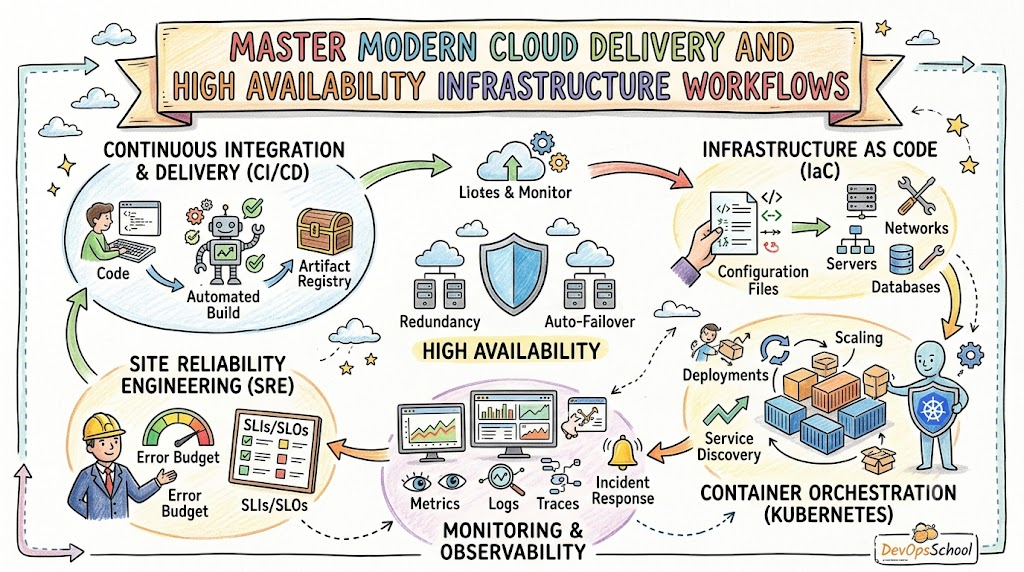
Continuous delivery platforms remove repetitive, manual procedures between source branches and production environments. Whenever engineers push code updates, automated test runners execute unit suites, evaluate code quality, and bundle container images.
Subsequently, deployment scripts publish verified containers into live staging and production environments using canary schedules. This rigorous build automation shrinks shipping intervals from several months to a few minutes while catching functional regressions immediately.
Why Infrastructure as Code Matters
Manual server provisioning through web consoles invites configuration drift, architectural discrepancies, and unexpected outages. In contrast, Infrastructure as Code establishes version-controlled configuration files for virtual clusters, networks, and storage buckets.
Using tools like Terraform and Ansible, engineers launch identical application environments across multiple cloud providers. As a direct result, organizations preserve disaster recovery plans, enforce configuration consistency, and conduct transparent peer reviews for all environmental modifications.
Containers and Kubernetes in Modern Engineering
Container technology bundles application binaries with their runtime libraries, ending the frustrating situation where code runs locally but crashes on remote servers. Docker images create dependable execution layers across local laptops, testing runners, and distributed cloud clouds.
Kubernetes coordinates these active container fleets by handling network routing, rolling updates, resource quotas, and self-healing restarts. For this reason, deep-dive Kubernetes Training China curricula empower system teams to manage high-traffic microservices platforms with resilience and operational precision.
Understanding Site Reliability Engineering
Site Reliability Engineering treats operational administration as a dedicated software development challenge. Rather than demanding absolute 100% uptime, site reliability teams define practical Service Level Objectives and monitor key Service Level Indicators.
Teams balance release cadences against system stability by tracking operational error budgets. Comprehensive SRE Training China programs train systems engineers to automate repetitive maintenance toil, lead blameless retrospective reviews, and build resilient incident recovery procedures.
Bringing Security Into the Development Lifecycle
Modern development teams no longer rely on external, late-stage security audits right before major release dates. Instead, DevSecOps incorporates automated security tests directly into daily pipeline runs from the very first code commit.
Automated pipelines run vulnerability assessments, open-source license inspections, and container image scans. For this reason, comprehensive DevSecOps Training China curricula teach engineering groups how to embed secrets management, access governance, and zero-trust policies directly into deployment chains.
Cloud Computing and Modern Infrastructure
Cloud providers offer fast provisioning for virtual compute nodes, distributed database engines, network balancers, and container clusters. However, utilizing resources across AWS, Microsoft Azure, or Google Cloud requires intentional architectural discipline.
Engineering organizations combine multiple cloud providers to limit infrastructure costs, avoid vendor lock-in, and expand system redundancy. Practical Cloud Computing Training China courses instruct technical teams on network design, identity authentication, expenditure tracking, and multi-region infrastructure operations.
Platform Engineering and Developer Experience
As microservices expand, forcing developers to manage cluster networks, ingress controllers, and storage drivers reduces primary application coding time. Consequently, platform engineers construct internal developer platforms that supply self-service capabilities for routine infrastructure tasks.
Platform groups establish standardized “golden paths” that automate deployment workflows while maintaining enterprise compliance policies. Enrolling in advanced Platform Engineering Training China helps system architects create intuitive developer portals that eliminate friction and boost engineering momentum.
The Rise of MLOps
Machine learning models require unique deployment workflows that standard software delivery pipelines cannot fully handle. Data drift, ongoing model evaluation, feature storage, and versioned datasets demand specialized operational monitoring.
MLOps bridges data science models with production web infrastructure using automated retraining loops and continuous model monitoring. Practical MLOps Training China programs show engineers how to serve models at scale, run distributed pipelines, and orchestrate containerized machine learning systems on Kubernetes.
Building an Effective DevOps Learning Roadmap
Acquiring modern systems knowledge demands an orderly progression through key operational capabilities:
| Phase | Focus Area | Core Technologies | Target Capability |
|---|---|---|---|
| Phase 1 | System Basics | Linux, Shell Scripting, Git, Networks | Operating system control & code tracking |
| Phase 2 | Continuous Delivery | Jenkins, GitHub Actions, Docker | Pipeline execution & container builds |
| Phase 3 | Code-Defined Systems | Terraform, Ansible, Cloud APIs | Declarative multi-cloud provisioning |
| Phase 4 | Container Clusters | Kubernetes, Helm, Ingress Controllers | Resilient container orchestration |
| Phase 5 | Reliability & Metrics | Prometheus, Grafana, OpenTelemetry | Real-time monitoring & SLO management |
This disciplined roadmap ensures learners acquire durable, hands-on production expertise rather than brief tool overviews.
Individual Learning vs Enterprise Training
Independent learners commonly browse disconnected internet guides, brief video clips, and sandbox repos. While solo reading sparks technical curiosity, it rarely exposes practitioners to high-load concurrency, corporate compliance gates, or large-scale production incidents.
In contrast, structured Corporate DevOps Training China tailors learning modules directly to an enterprise’s current architecture and toolchain. Synchronous team upskilling unifies delivery standards across engineering groups, accelerating project velocity and team collaboration.
When Organizations Need DevOps Consulting
Expanding companies frequently hit operational roadblocks like slow releases, unpredictable deployment rollbacks, ambiguous ownership, and ballooning cloud costs. These structural problems highlight fundamental gaps in architectural design and pipeline automation.
Partnering with specialized DevOps Consulting China advisors provides fresh architectural audits, pipeline evaluations, and maturity analyses. Seasoned consultants steer engineering leadership through cluster migrations, automated delivery platforms, and organizational delivery transformations.
How to Choose the Right DevOps Training Program
Selecting a high-value technical curriculum requires careful assessment of course projects, instructor experience, and practical labs:
- Production Realism: Prioritize courses that simulate multi-tier enterprise systems rather than basic script tutorials.
- Dedicated Sandbox Labs: Confirm the program supplies private cloud environments for unhindered hands-on experimentation.
- Recognized Accreditations: Choose accredited DevOps Certification China credentials that prove actionable technical proficiency to employers.
- Practitioner Mentorship: Learn from senior infrastructure engineers who actively solve real-world production outages.
Enrolling in thorough DevOps Training China programs equips technical specialists with high-value, production-ready capabilities.
Common Mistakes When Learning DevOps
Many novice engineers treat infrastructure engineering as a race to memorize commands for every trending open-source tool. Yet software utilities evolve quickly, while enduring principles like test automation, feedback loops, and immutable infrastructure remain steady.
Another widespread miscalculation involves skipping fundamental Linux commands, routing concepts, and basic access controls. Without grounding in operating systems, practitioners struggle to troubleshoot broken container overlays, volume mounts, and network failures.
Practical Skills That Matter in Production
Hiring managers consistently seek engineers who navigate live outages with calm, systematic debugging techniques. While writing configuration scripts provides value, fixing broken production rollouts under tight constraints proves superior capability.
Valuable operational skills include:
- Executing automated zero-downtime application deployments with blue-green switches.
- Building log collection clusters and distributed tracing across microservice networks.
- Debugging failing Kubernetes pods, memory constraints, and intermittent network timeouts.
- Hardening release pipelines with automated vulnerability detectors and secret managers.
Mastering these core competencies ensures engineers can protect application stability and ensure business continuity.
DevOps Career Opportunities in China
The rapid expansion of enterprise cloud adoption, financial platforms, smart vehicles, and artificial intelligence drives strong corporate recruitment for infrastructure talent across China. Major tech centers like Beijing, Shanghai, Shenzhen, and Hangzhou continuously hunt for qualified platform engineers.
Specialized roles like Cloud Infrastructure Architect, SRE Lead, and DevSecOps Specialist command impressive compensation packages and significant career mobility. Obtaining validated certifications helps skilled professionals stand out across competitive engineering applicant pools.
Why Practical Learning Is Important
Passive lecture viewing generates false technical confidence that quickly unravels during real service outages. Operating complex cloud platforms requires continuous muscle memory gained through actual terminal work, broken environments, and manual fixes.
When students build actual cloud networks, troubleshoot broken containers, and script pipeline recovery jobs, principles take root permanently. Hands-on laboratory training builds the troubleshooting instincts needed to oversee enterprise-critical production systems.
Practical Focus Across Modern Learning Tracks
Hands-on training initiatives deliver deep, mentor-supported programs designed for modern cloud environments. Curricula focus on full delivery lifecycles, enterprise architecture layouts, and real-time failure drills.
Engineers gain authentic experience managing container clusters, automated pipelines, reliability frameworks, and security integrations. Through active labs and expert guidance, students develop concrete technical strengths that solve immediate production problems.
Frequently Asked Questions
- Which technical prerequisites should students possess before enrolling?
Learners should understand fundamental Linux command-line operations, general networking principles, and basic scripting techniques using Python, Bash, or similar languages.
- Do students access realistic cloud environments during their coursework?
Instructors assign dedicated cloud sandbox accounts where students build end-to-end continuous delivery pipelines and multi-tier server clusters.
- How does an industry-recognized credential advance an engineering career?
Accredited certifications confirm your hands-on systems expertise to hiring managers, unlocking higher-tier job roles and confirming your technical readiness.
- Can enterprise teams request tailored training content for their tech stack?
Corporate programs adjust lesson modules to match an organization’s specific cloud providers, internal platforms, automation tools, and strategic objectives.
- How does site reliability engineering coursework differ from continuous delivery classes?
Continuous delivery training highlights automated software releases, whereas site reliability engineering emphasizes service resilience, incident handling, and telemetry monitoring.
- Will students troubleshoot real-world production failures during training?
Course modules include hands-on failure scenarios where participants analyze broken cluster networks, fix failing builds, and execute rollback plans.
- How do DevSecOps practices fit into standard deployment pipelines?
Security modules teach engineers to embed static code analysis, software dependency inspections, and container image scans directly into automatic build stages.
- Do course modules cover Kubernetes and container orchestration in depth?
The training covers container fundamentals, multi-node Kubernetes clusters, Helm chart management, ingress controllers, and GitOps workflows.
- Where can learners receive assistance when encountering lab blockers?
Experienced technical mentors provide direct code reviews, answer setup questions, and guide students through complex system configurations.
- Why do machine learning workflows require dedicated operational training?
MLOps coursework addresses unique challenges like training dataset versioning, model performance drift, continuous validation runs, and low-latency model inference servers.
Final Thoughts
Sustainable corporate competitiveness demands automated delivery processes and resilient cloud platforms. When teams replace fragmented release handoffs with unified deployment pipelines, they achieve high shipping speeds without compromising system reliability.
Enrolling in hands-on, mentor-led infrastructure courses equips engineers with the critical capabilities required to oversee modern cloud environments. Commit to continuous technical growth, refine your automation skills, and build robust software delivery platforms that withstand enterprise demands.
Leave a Reply