DataOps Certified Professional DOCP Complete Enterprise Engineering Career Guide

September 1, 2026 · 17 reads
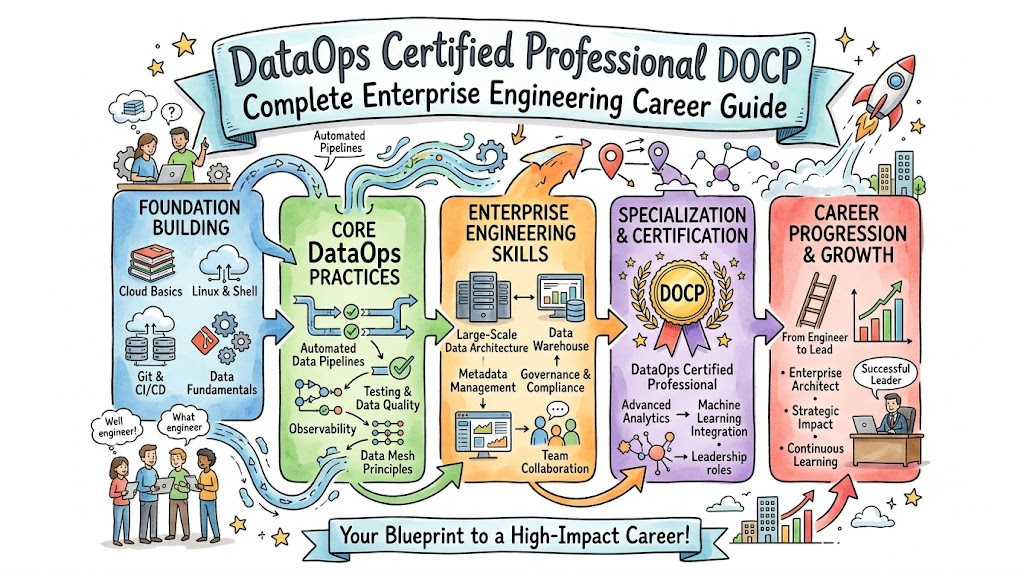
Enterprises depend heavily on continuous analytics, yet manual delivery scripts and silent schema mismatches frequently disrupt production workflows. Consequently, engineering organizations actively establish automated operational controls across their data lifecycles. This comprehensive roadmap inspects the DataOps Certified Professional (DOCP) credential offered through DevOpsSchool. Software engineers, data architects, platform practitioners, and technical managers can leverage this curriculum to build resilient data pipelines, automate testing gates, and master agile operational workflows.
Understanding DataOps Certified Professional (DOCP)
DataOps Certified Professional (DOCP) confirms that an engineer possesses the skills to apply continuous integration, infrastructure automation, and statistical quality monitoring directly to data pipelines. As a result, teams eliminate manual intervention and deliver reliable analytical models to stakeholders rapidly.
Furthermore, this certification prioritizes hands-on production engineering over abstract classroom theory. Participants master declarative infrastructure provisioning, automated regression testing, containerized data platforms, and distributed system observability. Because enterprise workloads expand rapidly, this program equips technical practitioners with the capabilities required to maintain highly dependable data ecosystems.
Candidate Profile and Target Audience
Data engineers, DevOps practitioners, cloud architects, and site reliability engineers benefit immediately from this credential. Additionally, backend developers seeking to transition into data platform engineering gain structured, end-to-end operational proficiencies.
Engineering leaders and technical directors utilize this framework to establish dependable deployment cadences across multi-disciplinary teams. Because modern organizations across North America, Europe, India, and the Asia-Pacific region demand automated data platforms, this credential delivers immediate global value.
Industry Relevance and Career Longevity
Modern organizations deploy streaming engines, machine learning pipelines, and distributed analytical storage at scale. However, undocumented upstream schema changes often break downstream models instantly, generating substantial business friction and operational downtime.
+--------------------+     +---------------------+     +--------------------+
|  Upstream Sources  | --> | Automated CI/CD &   | --> | Consumer Platforms |
| (Schemas, Events)  |     | Data Quality Engine |     |  (BI, AI Systems)  |
+--------------------+     +---------------------+     +--------------------+
Consequently, hiring managers actively seek professionals who can build, test, and monitor automated analytical pipelines. Earning this certification protects your long-term career trajectory because it teaches foundational architectural principles instead of transitory toolsets. Therefore, you directly improve release frequency, maintain pipeline stability, and accelerate operational velocity.
DataOps Certified Professional (DOCP) Program Framework
The curriculum uses realistic scenario-driven assessments designed around complex production failures. It evaluates pipeline architecture, declarative orchestration, automated validation gates, and telemetry implementations.
Moreover, candidates complete rigorous hands-on laboratory exercises and architectural capstones. This approach confirms that certified professionals can deploy, troubleshoot, observe, and restore enterprise data pipelines with complete confidence.
DevOpsSchool Platform Overview
DevOpsSchool serves as a global leader in enterprise engineering training, platform certifications, and operational consulting. Over the past decade, the organization has trained thousands of software engineers, cloud architects, and technology leaders across Fortune 500 enterprises.
Additionally, the institute emphasizes a practical, implementation-first teaching methodology. Instead of simple memorization drills, students solve production outages and construct live infrastructure in dedicated sandboxes. Guided by experienced principal engineers, participants acquire validated technical capabilities, permanent access to curriculum updates, and active community mentorship.
DataOps Certified Professional (DOCP) Certification Tracks & Levels
The curriculum features three progressive tiers: Foundation, Professional, and Advanced Architect levels. Each level validates deeper implementation competencies.
- Foundation Level: Focuses on baseline version control for schemas, containerization workflows, and declarative pipeline orchestration.
- Professional Level (DOCP): Validates automated quality testing, continuous deployment pipelines, infrastructure automation, and statistical process controls.
- Advanced Architect Level: Evaluates distributed data mesh topologies, regulatory compliance automation, multi-region disaster recovery, and enterprise governance patterns.
Complete DataOps Certified Professional (DOCP) Certification Table
| Track | Level | Who it’s for | Prerequisites | Skills Covered | Recommended Order |
|---|---|---|---|---|---|
| Data Operations | Foundation | Junior Data Engineers, System Admins | Basic Linux and SQL knowledge | Version Control, Schema Management, Basic Orchestration | 1 |
| Data Operations | Professional (DOCP) | Mid-Senior Data & DevOps Engineers | 2+ years of data or cloud operations | Pipeline CI/CD, Data Quality Automation, Observability | 2 |
| Data Operations | Advanced Architect | Principal Engineers, Data Architects | 5+ years of enterprise platform delivery | Data Mesh Governance, Zero-Trust Security, Chaos Engineering | 3 |
| Platform & SRE | Site Reliability | SREs, Platform Engineers | Production system operations | SLIs/SLOs for Data Pipelines, Incident Triage, Automated Healing | 4 |
| Cloud Governance | FinOps Integration | Cloud Architects, Financial Analysts | Cloud infrastructure fundamentals | Cost Attribution, Pipeline Right-Sizing, Resource Optimization | 5 |
Detailed Guide for Each DataOps Certified Professional (DOCP) Certification
DataOps Certified Professional (DOCP) – Professional Level
What it is
This credential validates an engineer’s capability to architect, automate, test, and maintain resilient data pipelines across hybrid and cloud environments.
Who should take it
Data practitioners, DevOps engineers, cloud platform developers, and software professionals with two or more years of technical experience should pursue this program.
Skills you’ll gain
- Constructing automated CI/CD workflows tailored to complex data transformations.
- Building automated data validation checkpoints to catch schema anomalies early.
- Provisioning scalable computing resources using declarative Infrastructure as Code.
- Implementing telemetry pipelines to monitor system latency, logs, and distributed traces.
- Orchestrating multi-stage extract and load pipelines safely across staging environments.
Real-world projects you should be able to do
- Deploy a complete CI/CD release workflow for analytical pipelines with automated regression suites.
- Implement a continuous data quality gate that isolates corrupt batches before storage ingestion.
- Build a unified observability dashboard tracking pipeline execution speed, schema drift, and resource costs.
Preparation plan
- 7–14 Days Plan: Review core architectural concepts, write automated schema validation scripts, and study declarative orchestration patterns.
- 30 Days Plan: Complete hands-on lab deployments, configure automated build systems for pipelines, and implement real-time metric collection.
- 60 Days Plan: Build sandbox architectures, simulate platform outages, implement automated rollback strategies, and conduct deep performance optimization.
Common mistakes
- Managing data pipelines like static application code without considering dynamic volume spikes.
- Neglecting automated tests for upstream contract changes and schema modifications.
- Prioritizing scheduling tools while completely ignoring proactive telemetry and alerting systems.
Best next certification after this
- Same-track option: DataOps Certified Architect
- Cross-track option: Site Reliability Engineering Certified Professional
- Leadership option: Certified Platform Engineering Leader
Choose Your Learning Path
DevOps Path
This roadmap helps engineers automate continuous integration, deployment pipelines, and infrastructure provisioning. You manage configurations as version-controlled software assets. Consequently, your team delivers reliable application updates rapidly across hybrid environments.
DevSecOps Path
This track integrates automated security checks directly into the continuous delivery pipeline. You configure automated code scanners, container image compliance checks, and runtime policies. As a result, you secure systems without slowing deployment cadences.
SRE Path
This curriculum prepares professionals to build scalable, resilient platforms with minimal downtime. You establish Service Level Objectives, build automated alerting frameworks, and eliminate operational toil. This expertise enables engineers to maintain high availability across distributed architectures.
AIOps Path
This path trains engineers to utilize machine learning models on infrastructure metrics, event logs, and operational telemetry. You build systems that identify performance bottlenecks automatically and trigger proactive self-healing scripts. Thus, your team resolves incidents before end-users experience outages.
MLOps Path
This specialization structures the entire lifecycle of machine learning models from training to production serving. You construct automated retraining pipelines, model registries, and drift detection monitors. Consequently, data science teams deploy production models with continuous reliability.
DataOps Path
This discipline teaches engineers to automate, test, and monitor analytical pipelines across enterprise environments. You implement agile release cadences, automated data validation gates, and elastic infrastructure provisioning. Therefore, data consumers access trustworthy insights continuously.
FinOps Path
This specialization establishes financial accountability across cloud infrastructure and platform architectures. You analyze real-time cost attribution, right-size workloads, and evaluate cloud unit economics. This enables engineering teams to maximize return on cloud investments.
Role → Recommended DataOps Certified Professional (DOCP) Certifications
| Role | Recommended Certifications |
|---|---|
| DevOps Engineer | DataOps Certified Professional (DOCP), CI/CD Automation Specialist |
| SRE | DataOps Certified Professional (DOCP), Site Reliability Practitioner |
| Platform Engineer | DataOps Certified Professional (DOCP), Cloud Platform Architect |
| Cloud Engineer | DataOps Certified Professional (DOCP), Infrastructure Automation Engineer |
| Security Engineer | DataOps Certified Professional (DOCP), DevSecOps Certified Professional |
| Data Engineer | DataOps Certified Professional (DOCP), DataOps Certified Architect |
| FinOps Practitioner | DataOps Certified Professional (DOCP), Cloud Financial Optimization Specialist |
| Engineering Manager | DataOps Certified Professional (DOCP), Enterprise Engineering Leader |
Next Certifications to Take After DataOps Certified Professional (DOCP)
Same Track Progression
Upon completing your initial professional credential, pursue advanced data platform architecture certifications. This progression deepens your knowledge of distributed data fabrics, multi-tenant governance, and large-scale data mesh topologies.
Cross-Track Expansion
Expand your technical scope by earning credentials in Site Reliability Engineering or DevSecOps. Combining data operational skills with system resilience and automated security allows you to construct enterprise-grade analytical platforms.
Leadership & Management Track
Engineers targeting leadership positions should pursue platform management and technical strategy credentials. These programs help you align engineering velocity with business goals, guide cross-functional teams, and build effective operational cultures.
Training & Certification Support Providers for DataOps Certified Professional (DOCP)
The Core Platform Authority
DevOpsSchool operates as the primary platform authority for comprehensive enterprise training, professional certifications, and modern operational engineering disciplines. The organization provides deeply structured curricula designed by principal engineers with decades of hands-on production experience. Through immersive, lab-driven coursework, live production scenario modeling, and comprehensive tool ecosystems, the platform equips candidates with practical capabilities required to operate mission-critical systems. Furthermore, its programs emphasize production readiness over simple test preparation, establishing an industry benchmark for quality and engineering excellence.
DevOpsSchool
DevOpsSchool delivers enterprise training programs spanning DevOps, DataOps, SRE, and cloud-native architecture. The platform features hands-on real-world labs, production project simulations, and mentorship from senior practitioners. Consequently, candidates gain actionable skills that apply directly to enterprise infrastructure.
Cotocus
Cotocus provides advanced IT consulting, specialized corporate certifications, and digital transformation services. The platform emphasizes deep technical implementation, containerization workflows, and scalable operational strategies. As a result, engineering teams accelerate their modern development and infrastructure delivery practices effectively.
Scmgalaxy
Scmgalaxy serves as an active technical community and training provider centered on source code management, continuous integration, and build automation. It provides comprehensive tutorials, tooling guides, and structured learning paths that help engineers master modern software release engineering.
BestDevOps
BestDevOps curates industry best practices, tool comparisons, and specialized training programs for cloud and platform professionals. The platform guides candidates through practical implementation patterns, helping teams build robust automation pipelines and modern infrastructure frameworks.
devsecopsschool.com
devsecopsschool.com delivers specialized education focused entirely on integrating security automation into modern delivery pipelines. The curriculum covers static and dynamic code scanning, container compliance, and cloud security governance, enabling engineers to secure systems effectively without compromising delivery speed.
sreschool.com
sreschool.com trains professionals in site reliability engineering, system resilience, and automated incident triage. Through rigorous scenario-driven labs, the platform teaches candidates to design reliable distributed architectures, establish meaningful SLOs, and eliminate operational overhead systematically.
aiopsschool.com
aiopsschool.com offers specialized coursework on utilizing artificial intelligence and machine learning for IT operations automation. The platform teaches engineers to ingest operational telemetry, identify anomalies automatically, and build self-healing infrastructure systems to ensure continuous platform availability.
dataopsschool.com
dataopsschool.com focuses exclusively on the disciplines of data operations, pipeline automation, and data quality engineering. It offers in-depth training on data orchestration, schema management, and automated continuous integration for modern analytics and data engineering platforms.
finopsschool.com
finopsschool.com provides targeted education on cloud financial management, cost allocation, and resource optimization. The platform prepares cloud professionals and managers to implement data-driven spending practices, manage cloud budgets effectively, and maximize business value from infrastructure investments.
Frequently Asked Questions (General)
- Which factors determine the difficulty level of an operations exam?
Prior hands-on laboratory experience heavily influences exam difficulty. Practical scenario-based assessments evaluate real-world troubleshooting and design abilities rather than simple memorization.
- How many hours should candidates dedicate to study each week?
Candidates typically spend four to eight weeks preparing, allocating five to ten hours each week for architectural reading and hands-on laboratory practice.
- Must candidates satisfy specific technical prerequisites before registering?
Most candidates succeed faster if they already understand Linux shell environments, relational database querying, and version control workflows.
- Which professional benefits do certified engineers realize?
Professionals regularly secure accelerated promotions, undertake larger platform engineering responsibilities, and obtain access to high-impact technical roles.
- Why should engineers choose vendor-neutral programs over proprietary ones?
Vendor-neutral programs emphasize universal architectural principles and operational frameworks, ensuring that your skills remain relevant across diverse cloud platforms.
- Can application developers successfully clear this operational exam?
Developers with strong programming backgrounds can leverage these courses to master infrastructure automation, continuous integration, and production monitoring.
- How many years does this operational credential remain active?
Industry credentials typically remain valid for two to three years, after which professionals renew their status or advance to architectural levels.
- Do examiners require candidates to finish hands-on laboratory exercises?
Scenario-based evaluations assess your ability to build and troubleshoot systems in live environments, making hands-on practice mandatory.
- Will this certification help engineers secure international employment?
Standardized technical credentials provide hiring managers with verified proof of your operational capabilities, streamlining recruitment across international organizations.
- Should engineering managers complete technical operations training?
Managers gain practical insight into pipeline bottlenecks, automated quality gates, and delivery metrics, enabling them to lead cross-functional engineering teams effectively.
- Which progression strategy yields the best career outcome?
Begin with foundational operations credentials, advance into specialized domain certifications, and finish with enterprise architecture or technical leadership programs.
- Can organizations purchase custom team training packages?
Institutions regularly deliver customized enterprise programs aligned with specific corporate tech stacks, delivery workflows, and architectural modernization roadmaps.
FAQs on DataOps Certified Professional (DOCP)
- Which primary operational areas does the DOCP curriculum cover?
The curriculum evaluates automated data pipeline construction, continuous integration for analytical workflows, proactive data quality verification, and infrastructure management. Candidates also learn to configure distributed observability systems to detect and remediate pipeline errors quickly.
- Where does DOCP differ from traditional database administration tracks?
Traditional database tracks focus on storage provisioning, query execution, and engine tuning. Conversely, DOCP teaches engineers how to automate, test, deploy, and monitor complex data pipelines across production environments.
- Which technical proficiencies should students possess prior to taking the exam?
Students should understand basic SQL querying, Python scripting, Linux command-line tools, and Git workflows. While previous cloud and container experience helps, instructors cover essential platform concepts during the course.
- Why do instructors place strong emphasis on automated quality validation?
Undetected schema mutations and malformed input records damage downstream business intelligence reports and machine learning models. DOCP teaches practitioners to build automated validation gates that intercept corrupted data before storage ingestion.
- How does this credential transform an engineer’s daily responsibilities?
Engineers move away from manual patching and reactive troubleshooting toward building robust, automated platform pipelines. This transition reduces operational toil, shortens delivery cycles, and elevates organizational confidence in production data.
- Will students learn how to work with modern cloud-native architectures?
The course incorporates container platforms, declarative infrastructure tools, distributed storage lakes, and modern workflow orchestrators, enabling candidates to manage pipelines across hybrid and multi-cloud platforms.
- Which production projects must candidates complete during their training?
Participants construct end-to-end continuous integration pipelines for data workflows, establish real-time operational monitoring dashboards, and deploy automated recovery workflows for broken pipeline runs.
- In what ways does DOCP improve cross-team engineering collaboration?
The program establishes common operational workflows, version control standards, and incident response protocols across data engineers, data scientists, and core DevOps teams.
Final Thoughts: Is DataOps Certified Professional (DOCP) Worth It?
Investing your time in professional certifications requires clear career alignment. If you routinely debug broken analytical pipelines, manage unexpected schema mutations, or deploy data updates manually, this program offers immediate, tangible solutions.
Instead of focusing on narrow tools that become outdated, this curriculum teaches enduring operational patterns, continuous testing frameworks, and architectural resilience. Mastering these production capabilities transforms you into an essential technical resource who successfully bridges the gap between software delivery workflows and enterprise data systems.
Leave a Reply