Complete Career Blueprint for SRE Certified Professional SRECP Engineers

August 18, 2026 · 11 reads
Introduction
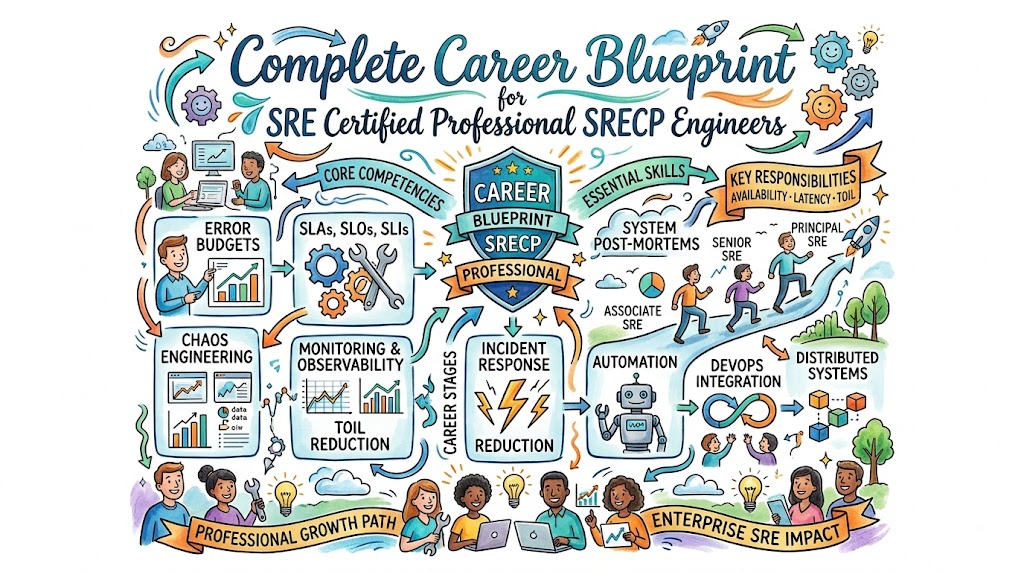
Engineering leaders expect distributed architectures to sustain heavy transactional loads without degrading customer experience. Therefore, technical teams must replace outdated infrastructure firefighting with rigorous, programmatic system reliability engineering. The SRE Certified Professional (SRECP) program from DevOpsSchool establishes a hands-on learning roadmap that transforms software developers and operations personnel into proactive platform specialists. Consequently, this career guide details the fundamental concepts, structured skill tracks, real-world case simulations, and actionable advancement pathways that define modern reliability mastery.
Complex microservices environments, dynamic container fabrics, and hybrid enterprise clouds introduce unpredictable failure states across production clusters. As a result, organizations actively prioritize engineers who replace manual operational triage with declarative configuration, unified telemetry, and automated self-healing mechanisms. Hence, this comprehensive breakdown delivers the strategic clarity that technical professionals require to evaluate skill paths, master core competencies, and advance their production platform careers.
What is the SRE Certified Professional (SRECP)?
The SRE Certified Professional (SRECP) program validates an engineer’s capability to solve operational scale bottlenecks using standard software engineering principles. Thus, the curriculum discards static system administration routines in favor of programmatic automation, automated failure budget governance, dynamic capacity forecasting, and deep observability instrumentation. Candidates systematically prove their proficiency in safeguarding high-availability service agreements while maintaining continuous software release cycles.
Furthermore, this qualification prioritizes production-grade implementation over abstract, theoretical concepts. Participants build automated error budget frameworks, configure distributed tracing pipelines, and orchestrate automated self-healing mechanisms inside realistic enterprise topologies. Because the coursework aligns directly with modern continuous deployment pipelines and cloud-native container ecosystems, certified engineers immediately drive measurable reliability improvements across production services.
Who Should Pursue SRE Certified Professional (SRECP)?
Cloud infrastructure engineers, systems administrators, platform builders, and backend developers gain immediate advantages from this structured reliability curriculum. Specifically, database administrators and streaming data engineers learn how to secure data integrity, automate cluster failovers, and optimize throughput under variable production loads. In addition, quality engineering specialists acquire the technical depth necessary to embed automated resilience testing directly into continuous integration workflows.
Moreover, the course structure supports early-stage platform practitioners establishing baseline production competencies as well as principal architects refining enterprise platform governance. From an industry standpoint, global tech firms and leading development teams across India aggressively recruit credentialed specialists to minimize recovery intervals and eliminate system fragility. Similarly, technical managers and enterprise directors use this standardized framework to establish unified service-level metrics and shared operational accountability across disparate engineering squads.
Why SRE Certified Professional (SRECP) is Valuable in Modern Engineering
Modern cloud architectures make continuous service reliability a fundamental driver of business revenue. Consequently, enterprise organizations actively invest in technical talent capable of quantifying operational risk and deploying programmatic resilience safeguards. The SRE Certified Professional (SRECP) credential builds enduring career stability because it emphasizes foundational distributed systems design rather than temporary, proprietary toolsets.
Additionally, mastering code-driven reliability patterns empowers engineers to navigate changes in orchestration engines, runtime environments, and public cloud providers effortlessly. Prioritizing structured reliability practices delivers substantial returns on time investment by accelerating incident resolution, eliminating manual toil, and ensuring release stability. Ultimately, achieving this certification demonstrates your capability to align platform engineering controls directly with core enterprise availability goals.
SRE Certified Professional (SRECP) Certification Overview
This hands-on program utilizes scenario-driven evaluations to assess an engineer’s ability to resolve critical production disruptions within enterprise sandboxes. Therefore, candidates troubleshoot active latency spikes, diagnose distributed network bottlenecks, parse asynchronous telemetry signals, and deploy automated recovery workflows under real-time conditions. This rigorous evaluation confirms that certified engineers possess the technical maturity required to defend mission-critical architectures during major service failures.
Furthermore, the curriculum maintains an uncompromising focus on practical implementation, dedicating substantial time to writing automation code rather than reading conceptual manuals. Learners master infrastructure-as-code scripting, OpenTelemetry instrumentation, distributed trace correlation, post-incident review workflows, and error budget policy design. As a result, credential holders deliver immediate, quantifiable architectural value upon entering modern enterprise engineering teams.
Why Choose DevOpsSchool
DevOpsSchool delivers enterprise-grade technical training designed to equip technology teams with practical, industry-standard engineering capabilities. Furthermore, the platform specializes in high-impact domains including platform automation, cloud infrastructure design, site reliability engineering, continuous security integration, and enterprise operational workflows. Learners receive unrestricted access to curated interactive labs, complete architectural blueprints, and validated technical curricula that reflect real-world enterprise infrastructure challenges.
Additionally, the institute leverages veteran technical mentors who bring decades of real-world production engineering experience directly into every training module. DevOpsSchool combines interactive sandbox environments, round-the-clock lab availability, structured enterprise mentorship tracks, and continuous career advisory resources to drive professional transformation. Therefore, this intensive focus on verifiable execution ensures candidates pass challenging certification assessments while driving successful platform transformations inside global engineering organizations.
SRE Certified Professional (SRECP) Tracks & Levels
The certification roadmap organizes platform reliability learning into distinct, progressive tiers that support continuous professional development. Initially, foundation levels teach engineers to eliminate repetitive manual tasks, configure unified metric aggregators, and calculate fundamental service level indicators. Subsequently, practitioners advance to professional tracks where they orchestrate progressive traffic rollouts, distributed telemetry pipelines, and automated error budget enforcement policies.
Finally, advanced tiers prepare senior architects, principal systems engineers, and technical leaders to direct organization-wide resilience strategies and manage complex multi-region platforms. These specialized paths connect reliability engineering with adjacent disciplines including automated platform compliance, continuous pipeline delivery, and strategic cloud financial optimization. Consequently, this multi-tiered progression establishes clear career milestones, guiding engineers from basic operational support into high-level platform architecture.
Complete SRE Certified Professional (SRECP) Certification Roadmap
| Track | Level | Who it’s for | Prerequisites | Skills Covered | Recommended Order |
|---|---|---|---|---|---|
| SRE Foundations | Associate | Junior SREs, System Admins | Basic Linux, Scripting | SLI/SLO Concepts, Metrics, Basic Triage | 1 |
| SRE Operations | Professional | SREs, Cloud Engineers | Linux Admin, Containers | Observability, Tracing, Chaos Engineering | 2 |
| SRE Architecture | Advanced | Principal SREs, Architects | Multi-Cloud, Distributed Systems | Capacity Modeling, High Availability Design | 3 |
| SRE Automation | Professional | Platform Engineers, DevOps | Python/Go, CI/CD Pipelines | Auto-Remediation, Custom Operators | 4 |
| SRE Governance | Expert | Engineering Directors, Leads | Incident Management, Systems Design | Error Budget Policies, Postmortems | 5 |
Detailed Guide for Each SRE Certified Professional (SRECP) Certification
SRE Certified Professional (SRECP) – Foundation Level
What it is
The Foundation Level validates an engineer’s understanding of core reliability patterns, service level definitions, and real-time infrastructure health tracking. Furthermore, it establishes practical competency in collecting system telemetry, consolidating application logs, and eliminating repetitive operational toil through automation.
Who should take it
This entry-level track suits junior infrastructure administrators, cloud operators, entry-level DevOps practitioners, and software engineers transitioning toward platform operations.
Skills you’ll gain
- Calculating, establishing, and tracking Service Level Indicators (SLIs) and Service Level Objectives (SLOs)
- Constructing centralized monitoring dashboards and real-time metric visualization boards
- Developing Python and Bash automation scripts to eradicate manual operational overhead
- Executing structured incident triage routines and following defined escalation protocols
- Maintaining containerized application workloads across staging and production clusters
Real-world projects you should be able to do
- Deploy a complete Prometheus and Grafana telemetry collection stack for microservices workloads
- Build automated alert routing triggered by latency degradation and abnormal error spikes
- Write automated scripts to manage continuous database health checks and log cleanup routines
Preparation plan
- 7–14 Days: Master basic reliability terminology, calculate sample error budgets, and complete core Linux troubleshooting exercises.
- 30 Days: Configure end-to-end local monitoring pipelines using open-source collectors, visual dashboards, and notification alerts.
- 60 Days: Implement metric instrumentation across multiple microservices and run simulated incident postmortem analyses.
Common mistakes
- Mistaking raw server uptime percentages for actionable, customer-centric Service Level Objectives
- Configuring excessive notification thresholds that generate operational alert fatigue
- Neglecting to version-control standard operational runbooks alongside application code
Best next certification after this
- Same-track option: SRE Certified Professional (SRECP) – Advanced Practitioner
- Cross-track option: Certified Kubernetes Administrator (CKA)
- Leadership option: Certified Platform Engineering Lead
SRE Certified Professional (SRECP) – Professional Level
What it is
The Professional Level certifies advanced technical capability in operating resilient distributed platforms, instrumenting end-to-end observability fabrics, and establishing automated error budget guardrails.
Who should take it
This course targets mid-level Site Reliability Engineers, cloud operations specialists, platform developers, and senior DevOps engineers managing high-throughput production environments.
Skills you’ll gain
- Instrumenting distributed tracing pipelines across multi-tier microservices topologies
- Executing controlled chaos engineering injections using modern fault-simulation tools
- Automating canary deployment strategies, traffic shaping, and progressive rollback rules
- Directing blameless post-incident reviews and tracking quantitative remediation milestones
- Programming automated remediation handlers for recurring infrastructure failure modes
Real-world projects you should be able to do
- Integrate OpenTelemetry distributed request tracing across a containerized polyglot platform
- Execute automated Chaos Mesh simulations to evaluate Kubernetes failover resilience
- Program custom Kubernetes controllers that dynamically scale workloads based on transaction latency
Preparation plan
- 7–14 Days: Review distributed tracing patterns, OpenTelemetry collector architectures, and container network failure domains.
- 30 Days: Construct and validate automated chaos injection pipelines and progressive delivery controllers in test sandboxes.
- 60 Days: Build complete automated incident self-healing workflows and enforce production error budget policies.
Common mistakes
- Tracking raw compute utilization while overlooking end-user application latency and throughput
- Deploying automated recovery scripts without testing them against complex cascading failures
- Treating postmortems as administrative paperwork instead of prioritizing remediation tasks in engineering backlogs
Best next certification after this
- Same-track option: SRE Certified Professional (SRECP) – Master Architect
- Cross-track option: Certified DevSecOps Professional
- Leadership option: Certified Engineering Reliability Director
SRE Certified Professional (SRECP) – Advanced Level
What it is
The Advanced Level validates executive-level technical leadership, resilient distributed architecture design, quantitative capacity forecasting, and enterprise-wide reliability program governance.
Who should take it
This tier targets principal systems architects, enterprise infrastructure strategists, staff platform engineers, and technical directors leading broad reliability initiatives.
Skills you’ll gain
- Architecting multi-region, active-active failover platforms and continuous disaster recovery workflows
- Constructing quantitative capacity forecasting algorithms to handle variable seasonal traffic demands
- Designing enterprise-grade telemetry ingestion pipelines capable of processing petabyte-scale event streams
- Establishing organization-wide error budget policies that balance feature releases with platform stability
- Structuring and scaling cross-functional site reliability engineering teams across global business units
Real-world projects you should be able to do
- Architect a zero-downtime, multi-region active-active disaster recovery framework across cloud environments
- Construct an algorithmic capacity model that forecasts infrastructure bottlenecks under extreme transaction loads
- Implement an enterprise-wide reliability standard featuring automated cross-team error budget governance
Preparation plan
- 7–14 Days: Study distributed database consensus algorithms, split-brain recovery, and global traffic routing policies.
- 30 Days: Draft complete architectural designs for enterprise multi-region disaster recovery and failover automation.
- 60 Days: Build full enterprise resilience governance frameworks combining compliance requirements and technical controls.
Common mistakes
- Designing complex multi-region replication architectures without accounting for cross-region data synchronization latency
- Confining reliability practices to an isolated operations team rather than embedding them across the organization
- Failing to link operational error budget metrics directly to executive business revenue outcomes
Best next certification after this
- Same-track option: SRE Certified Professional (SRECP) – Fellow Fellowships
- Cross-track option: Enterprise Cloud Solutions Architect
- Leadership option: Strategic Technology Leadership Professional
Choose Your Learning Path
DevOps Path
The DevOps learning trajectory establishes strong continuous integration, automated deployment, and declarative configuration baselines across your delivery pipeline. Engineers master version-controlled infrastructure provisioning, build automation, container registries, and progressive delivery patterns. This path ensures fast, predictable software delivery cycles while maintaining consistent configuration baselines across all development stages.
DevSecOps Path
The DevSecOps curriculum embeds automated security governance directly into all phases of the software release lifecycle. Practitioners implement static code analysis, software bill of materials validation, dynamic security scans, and runtime compliance controls into active CI/CD pipelines. This progression prevents operational security vulnerabilities from reaching production clusters without slowing down engineering deployment cadence.
SRE Path
The Site Reliability Engineering path focuses on creating highly resilient, scalable, and self-healing distributed platforms. Participants master the science of service level objectives, distributed tracing, automated error budget enforcement, and systematic toil elimination. This specialization transforms traditional operational environments into modern, code-driven reliability systems capable of withstanding production disruptions.
AIOps Path
The AIOps path leverages machine learning models, statistical pattern analysis, and automated anomaly detection to optimize complex IT operations. Engineers learn to ingest massive telemetry streams, correlate cross-system events, and isolate root causes during complex system failures. This specialized trajectory significantly reduces operational noise and speeds up mean time to resolution across high-volume infrastructure.
MLOps Path
The MLOps specialization bridges the operational gap between machine learning model development and scalable production platform delivery. Practitioners learn to build automated model training, validation, packaging, deployment, and performance monitoring pipelines. This path ensures predictive models run securely and reliably under fluctuating user demands while preventing data drift and degradation.
DataOps Path
The DataOps learning path applies Agile and reliability principles directly to enterprise data engineering and analytical pipelines. Professionals master automated data validation, continuous pipeline testing, data lake governance, and performance optimization across distributed data stores. This trajectory ensures high data quality, consistent schema validation, and reliable analytics delivery across modern data platforms.
FinOps Path
The FinOps path introduces collaborative financial accountability, cloud cost optimization, and resource governance directly into technical workflows. Practitioners learn to trace infrastructure expenditures, implement automated cloud rightsizing, establish budget guardrails, and forecast capacity demands. This specialization allows engineering teams to maximize the business value of every dollar invested in cloud infrastructure.
Role → Recommended SRE Certified Professional (SRECP) Certifications
| Role | Recommended Certifications |
|---|---|
| DevOps Engineer | SRE Certified Professional (SRECP) – Operations, Certified CI/CD Pipeline Specialist |
| SRE | SRE Certified Professional (SRECP) – Advanced, Chaos Engineering Practitioner |
| Platform Engineer | SRE Certified Professional (SRECP) – Automation, Kubernetes Operations Specialist |
| Cloud Engineer | SRE Certified Professional (SRECP) – Foundation, Multi-Cloud Infrastructure Engineer |
| Security Engineer | SRE Certified Professional (SRECP) – Operations, DevSecOps Automated Security Lead |
| Data Engineer | SRE Certified Professional (SRECP) – Foundation, DataOps Infrastructure Specialist |
| FinOps Practitioner | SRE Certified Professional (SRECP) – Governance, Cloud Financial Optimization Lead |
| Engineering Manager | SRE Certified Professional (SRECP) – Advanced Level, Technology Governance Professional |
Next Certifications to Take After SRE Certified Professional (SRECP)
Same Track Progression
Advancing within the reliability discipline involves mastering specialized production capabilities including chaos engineering, kernel-level tracing, and distributed disaster recovery. Senior practitioners typically pursue expert-level certifications in advanced Kubernetes operations, network reliability engineering, and specialized platform self-healing systems. These deep technical qualifications prepare professionals to take ownership of complex multi-cloud enterprise footprints.
Cross-Track Expansion
Broadening your technical skill set requires pursuing complementary qualifications across automated security, modern platform development, and intelligent observability. Practitioners often earn certifications in advanced DevSecOps pipelines, automated compliance testing, and machine-learning-driven operations. Combining deep reliability skills with adjacent cloud specialties increases your versatility and strategic value within cross-functional platform teams.
Leadership & Management Track
Transitioning toward engineering leadership requires developing strategic platform governance, organizational design, and financial optimization capabilities. Engineers in this stage transition into specialized platform leadership, technology architecture governance, and executive cloud cost optimization certifications. These advanced management credentials validate your ability to lead high-performing operational teams and manage enterprise-wide platform investments.
Training & Certification Support Providers for SRE Certified Professional (SRECP)
The Core Platform Authority
DevOpsSchool serves as a premier technical education institution dedicated to empowering engineers and technology enterprises through real-world, industry-standard training programs. The platform focuses exclusively on high-impact disciplines including site reliability engineering, cloud architecture, platform automation, security integration, and advanced operational workflows. Participants gain access to curated digital environments, exhaustive architectural blueprints, and industry-validated coursework designed to address the complex requirements of modern software organizations.
The organization employs experienced principal practitioners who integrate decades of production engineering insights directly into the classroom curriculum. DevOpsSchool emphasizes interactive labs, round-the-clock infrastructure access, customized enterprise mentorship tracks, and continuous career guidance to ensure sustained professional transformation. This focus on verifiable implementation skills ensures learners not only clear rigorous certification exams but also successfully execute complex platform transformations within global enterprise teams.
DevOpsSchool
DevOpsSchool provides comprehensive educational tracks designed to guide engineers through production operations, platform engineering, and reliability architectures. The platform delivers extensive practical exercises, deep architectural tutorials, and customized enterprise curriculum modules. Learners access realistic multi-cloud sandboxes to master automated deployment pipelines, infrastructure-as-code patterns, and complex container orchestration systems under the direction of veteran platform architects.
Cotocus
Cotocus delivers advanced technical enablement programs focused on corporate DevOps transformations, containerized architectures, and modern cloud operational standards. The organization assists engineering teams in establishing reliable delivery pipelines, automated configuration management, and robust infrastructure monitoring. Its curriculum emphasizes collaborative engineering workflows, production readiness reviews, and scalable system administration practices tailored to enterprise constraints.
Scmgalaxy
Scmgalaxy functions as an established knowledge hub and training platform specializing in software configuration management, build automation, and platform reliability fundamentals. The community provides technical documentation, implementation runbooks, and curated instructional courses covering key open-source tool ecosystems. Practitioners benefit from structured learning materials designed to enhance daily build automation, environment provisioning, and pipeline troubleshooting.
BestDevOps
BestDevOps curates dedicated instructional resources, career roadmaps, and certification prep programs focused on continuous integration, deployment, and cloud operations. The platform guides candidates through essential tool suites, automation best practices, and enterprise workflow standards. Its content focuses on platform engineering concepts and operational best practices.
devsecopsschool.com
devsecopsschool.com delivers specialized education focused on embedding proactive security controls, compliance governance, and vulnerability scanning directly into modern release cycles. The platform trains engineers to automate container scanning, source code analysis, and infrastructure security auditing. Through practical implementations, learners discover how to protect mission-critical environments without compromising rapid software delivery.
sreschool.com
sreschool.com dedicates its training resources exclusively to the discipline of site reliability engineering, system observability, and high-availability operations. The curriculum immerses engineers in the practical application of error budget policies, distributed telemetry analysis, and automated failure remediation. Participants work with real-world scenarios to design robust self-healing architectures and maintain modern platform stability.
aiopsschool.com
aiopsschool.com specializes in leveraging artificial intelligence algorithms, statistical modeling, and machine learning systems to optimize enterprise operational workflows. The platform teaches engineers how to automate anomaly detection, correlate complex system alerts, and isolate root causes across large-scale distributed logs. Training programs help teams transition from manual triage toward intelligent, automated operational systems.
dataopsschool.com
dataopsschool.com provides targeted educational programs focusing on agile data pipeline engineering, automated data quality validation, and scalable infrastructure management. Learners master techniques to ensure continuous data delivery, automated schema testing, and robust data store scaling across cloud platforms. The curriculum ensures data engineers build maintainable, error-free analytics systems that support business decisions.
finopsschool.com
finopsschool.com focuses on the financial optimization, cost attribution, and resource governance necessary to manage enterprise cloud spending effectively. The platform educates cross-functional engineering and finance teams on implementing automated cloud rightsizing, budget monitoring, and unit economics tracking. Participants learn to cultivate a culture of financial accountability across distributed software engineering initiatives.
Frequently Asked Questions (General)
- How do reliability credentials differ fundamentally from traditional infrastructure administration certifications?Reliability programs validate an engineer’s ability to apply programmatic software solutions to operational scaling bottlenecks instead of relying on manual hardware maintenance.
- How much study time must a full-time engineer dedicate to complete this program successfully?Candidates usually master the curriculum within four to eight weeks by investing five to seven hours weekly into hands-on lab environments.
- Must candidates possess prior programming or scripting proficiency before enrolling?Yes, candidates must understand automation scripting using languages such as Python, Go, or advanced Bash to complete the practical assignments.
- Which foundational prerequisites best prepare candidates for professional-level coursework?Engineers should understand core Linux administration, transport networking protocols, container orchestration fundamentals, and cloud platform services.
- How do engineering directors quantify the organizational return on investment from certified staff?Organizations measure direct returns through reduced mean time to recovery, accelerated deployment cycles, lower cloud infrastructure waste, and minimized downtime costs.
- Should infrastructure engineers earn baseline cloud certifications prior to starting this track?Completing foundational cloud practitioner courses gives useful baseline context, though deep hands-on Linux and networking proficiency remains far more valuable.
- How frequently do examination boards update curriculum standards to match industry tooling?Technical committees refresh the sandbox environments regularly to incorporate modern telemetry protocols, container engines, and progressive release controllers.
- Do global technology companies and multinational enterprises recognize this credential?Yes, enterprise employers worldwide actively seek out credentialed practitioners to manage high-throughput, multi-region distributed cloud platforms.
- Which testing methodologies evaluate a candidate’s actual operational capabilities?Assessments use scenario-driven evaluations and live sandbox environments where candidates triage active latency issues, fix service disruptions, and deploy automation scripts.
- Can application software developers transition smoothly into platform reliability engineering?Application developers transition rapidly because their software design background enables them to automate operations and build reliable self-healing systems.
- Which learning sequence serves engineers starting completely new to platform operations?Begin with core Linux administration and networking, advance into continuous integration automation, and complete specialized reliability engineering certifications.
- Do enrolled candidates receive continued access to alumni networks and updated technical material?Yes, graduates maintain ongoing access to architectural whitepapers, continuous learning repositories, and an international community of platform specialists.
FAQs on SRE Certified Professional (SRECP)
- Which core reliability concepts form the foundation of the SRE Certified Professional (SRECP) curriculum?The program concentrates on defining measurable service level indicators, enforcing objective error budgets, eliminating repetitive operational toil, configuring progressive deployments, and orchestrating blameless incident retrospectives. Engineers master treating operational complexity as a software challenge, utilizing OpenTelemetry pipelines and chaos testing to validate platform resilience against production degradation.
- How does holding the SRE Certified Professional (SRECP) credential elevate a candidate during enterprise technical interviews?This qualification verifies that an engineer possesses proven production troubleshooting capabilities rather than abstract conceptual knowledge. Hiring directors know that credentialed professionals understand how to balance rapid feature deployment against platform stability, architect distributed cloud platforms, and reduce operating costs through automated self-healing scripts.
- Does the coursework include practical implementation of end-to-end observability architectures?Yes, the curriculum requires learners to instrument polyglot microservices architectures with modern OpenTelemetry frameworks, configure distributed tracing collectors, aggregate system event logs, and build actionable alerting boards. Practitioners learn to isolate operational bottlenecks from complex telemetry streams rather than reacting to uncoordinated metric alarms.
- How does this qualification help engineering teams optimize their enterprise cloud spending?The curriculum trains engineers to model infrastructure capacity accurately, implement dynamic workload auto-scaling based on business transactions, and eliminate oversized cloud instances safely. By designing efficient systems that align compute consumption directly with user traffic, certified practitioners prevent cloud sprawl while maintaining high platform performance.
- Which specific chaos testing methodologies do engineers implement during the program?Learners formulate scientific failure hypotheses, configure targeted fault-injection tests, and execute chaos simulations targeting network latency spikes, node evictions, and disk exhaustion. This proactive validation allows engineering teams to detect and fix distributed microservices vulnerabilities before they cause customer-facing platform outages.
- Can enterprise organizations customize the SRE Certified Professional (SRECP) curriculum for internal engineering departments?Yes, corporate training pathways adapt the curriculum to match an enterprise’s specific cloud architectures, container orchestration engines, and operational runbooks. This targeted approach enables entire engineering divisions to implement standardized service level metrics, unified telemetry collectors, and consistent incident escalation protocols.
- How does the certification integrate continuous security governance with platform reliability practices?The coursework embeds automated compliance policies, fine-grained access governance, and vulnerability mitigation directly into everyday operational workflows. Candidates learn to build self-healing platforms that safeguard sensitive credentials, maintain runtime security baselines, and isolate compromised services without disrupting production traffic.
- Which high-level career paths open up after completing the SRE Certified Professional (SRECP) track?Credential holders frequently transition into high-impact roles including Lead Reliability Specialist, Principal Platform Architect, Enterprise Infrastructure Strategist, and Vice President of Cloud Operations. This certification provides the technical depth required to manage large-scale cloud footprints, shape technology strategy, and guide major modernization programs.
Final Thoughts: Is SRE Certified Professional (SRECP) Worth It?
Committing time to technical credentials demands a clear alignment between study effort and long-term career advancement. Platform reliability has evolved into a mandatory requirement for any enterprise operating modern distributed architectures. Earning this qualification confirms that you possess the disciplined software engineering expertise necessary to solve critical scalability, performance, and uptime challenges.
Furthermore, if you want to move beyond reactive administrative maintenance and direct core platform strategies, this certification provides an actionable, production-focused pathway. The coursework bypasses superficial tool overviews to build a deep understanding of distributed resilience, system telemetry, and programmatic operations. Ultimately, for engineers dedicated to designing robust, scalable, and high-performance cloud environments, this credential represents a pragmatic, high-value career milestone.
Leave a Reply