Accelerate High Impact Engineering Careers With Practical DevSecOps Professional Credentials

August 17, 2026 · 21 reads
Introduction
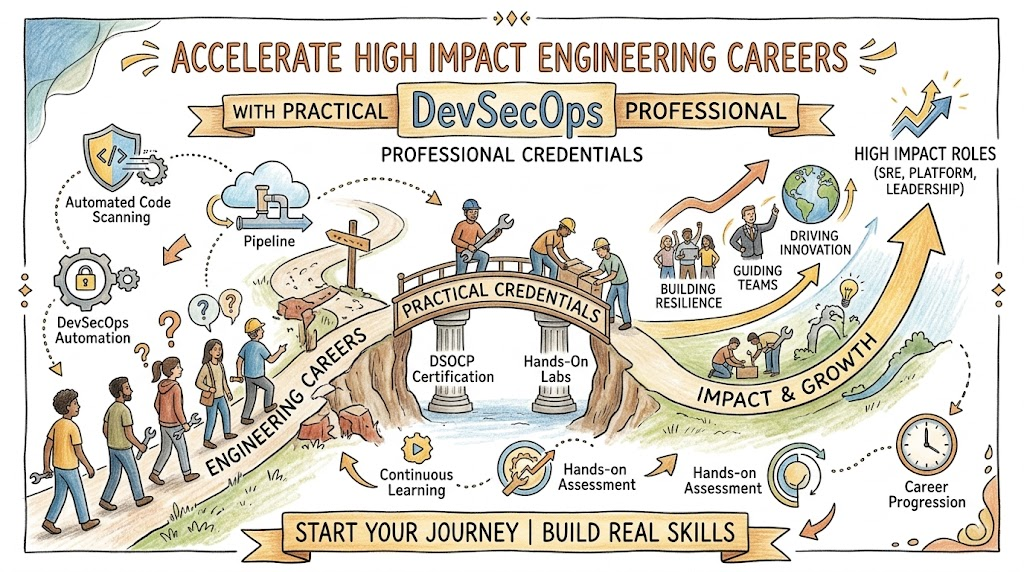
Modern cloud architectures demand integrated security controls across every deployment phase. Consequently, technical teams actively seek the DevSecOps Certified Professional (DSOCP) program from DevOpsSchool to validate production-grade security engineering skills. Furthermore, this comprehensive guide equips software engineers, platform specialists, and security practitioners with clear direction on career progression, skill acquisition, and enterprise impact. Therefore, readers discover actionable strategies to embed security automation, accelerate delivery cycles, and establish resilient deployment workflows across distributed architectures.
What is the DevSecOps Certified Professional (DSOCP)?
The DevSecOps Certified Professional (DSOCP) credential represents a comprehensive validation of an engineer’s ability to embed security automation across continuous integration and continuous deployment pipelines. Specifically, it moves beyond abstract compliance theory to emphasize practical tooling, automated policy enforcement, and infrastructure hardening.
Engineers proactively identify vulnerabilities within source code, container images, third-party dependencies, and infrastructure definitions before systems reach production. As a result, this industry-aligned program directly reflects how progressive technology organizations operate cloud-native environments at enterprise scale.
Who Should Pursue DevSecOps Certified Professional (DSOCP)?
This credential serves software developers, DevOps practitioners, site reliability engineers, cloud architects, and dedicated application security specialists seeking to operationalize security workflows. Additionally, technical leads and engineering managers benefit significantly by mastering governance guardrails without sacrificing feature velocity.
Practitioners worldwide and across the Indian tech ecosystem gain substantial advantages from this pathway. Because organizations actively transition away from isolated security reviews toward shared engineering responsibility, demand continues to surge for professionals who can bridge software development, systems operations, and security governance.
Why DevSecOps Certified Professional (DSOCP) is Valuable in the Current Tech Landscape
Organizations ship code at unprecedented frequencies, which renders traditional manual security audits obsolete. Thus, the DevSecOps Certified Professional (DSOCP) program equips engineers with transferable security automation frameworks that outlast volatile tooling trends and platform migrations.
Enterprise leaders prioritize candidates who demonstrate proactive risk mitigation, automated compliance verification, and rapid incident isolation. Ultimately, investing in this credential delivers an immediate return on professional credibility, elevating engineers into high-impact architectural and platform-governance roles.
DevSecOps Certified Professional (DSOCP) Certification Overview
The program delivers rigorous instruction through interactive labs, architectural case studies, and practical tool integrations. Accordingly, participants explore static and dynamic code analysis, container vulnerability scanning, secrets management systems, and automated policy-as-code frameworks.
Assessment strategies emphasize real-world execution rather than passive multiple-choice memorization. Engineers complete practical evaluation scenarios where they fix vulnerable pipelines, implement runtime protection agents, and establish production-grade compliance guardrails across distributed architectures.
Why Choose DevOpsSchool
DevOpsSchool stands out as an established global platform dedicated to advancing modern engineering practices through practitioner-led instruction. The platform delivers specialized, industry-relevant curriculum designed by senior architects who bring decades of real enterprise infrastructure experience into the classroom.
Learners benefit from extensive live lab environments, lifetime access to technical resources, interactive mentorship, and direct exposure to production tooling. Furthermore, the platform’s holistic approach ensures that candidates acquire deep operational problem-solving capabilities alongside conceptual clarity.
DevSecOps Certified Professional (DSOCP) Certification Tracks & Levels
The curriculum spans progressive tiers starting with core foundations, advancing to professional implementation, and concluding with strategic enterprise architecture. This tiered progression allows engineers to enter at their current skill baseline and systematically build production mastery.
Specialization tracks enable engineers to align security automation with site reliability engineering, cloud infrastructure, data pipelines, and financial operations. Each milestone directly reflects the escalating complexity of real-world enterprise infrastructure challenges.
Complete DevSecOps Certified Professional (DSOCP) Certification Table
| Track | Level | Who it’s for | Prerequisites | Skills Covered | Recommended Order |
|---|---|---|---|---|---|
| Security Fundamentals | Foundation | Associate Engineers, Analysts | Basic Linux and Git | Threat Modeling, SAST, Basic CI/CD | 1 |
| Core Pipeline Security | Professional | DevOps, Security Engineers | Scripting, Container Basics | DAST, SCA, Secrets Management, OPA | 2 |
| Cloud Infrastructure Security | Professional | Cloud and Platform Engineers | Cloud Platform Basics | Terraform Hardening, CSPM, IAM | 3 |
| Container & K8s Security | Professional | SREs, Kubernetes Admins | Docker and K8s Administration | Admission Controllers, Falco, Trivy | 4 |
| Enterprise Governance | Advanced | Leads, Security Architects | Advanced Cloud and CI/CD | Enterprise Guardrails, SLSA, SBOM | 5 |
Detailed Guide for Each DevSecOps Certified Professional (DSOCP) Certification
DevSecOps Certified Professional (DSOCP) – Core Track
What it is
This credential validates your ability to design, deploy, and manage automated security guardrails across the entire development pipeline. Furthermore, it confirms direct proficiency in pipeline hardening, vulnerability discovery, and automated compliance auditing.
Who should take it
DevOps practitioners, cloud administrators, and software developers with one to three years of delivery background who plan to specialize in automated pipeline protection.
Skills you’ll gain
- Implement automated static and dynamic security scanning engines
- Run software composition analysis to audit third-party open-source dependencies
- Scan container images and fix underlying operating system layer flaws
- Check infrastructure-as-code templates using automated compliance rules
- Deploy centralized vault infrastructure to automate credential rotation
Real-world projects you should be able to do
- Construct a multi-stage continuous delivery pipeline that blocks builds containing critical flaws
- Deploy a production secrets cluster that injects short-lived credentials into container workloads
- Write automated policy rules using Open Policy Agent to evaluate infrastructure templates
Preparation plan
- 7–14 Days: Review core pipeline security patterns, threat modeling concepts, and basic scanning tools.
- 30 Days: Complete hands-on labs covering SAST, DAST, SCA tools, and container image scanners.
- 60 Days: Build end-to-end production pipelines integrating policy engines, secrets management, and automated incident alerting.
Common mistakes
- Focusing exclusively on scanning tools without learning remediation strategies
- Ignoring pipeline execution speed, which creates developer friction
- Overlooking secrets management fundamentals in container runtime environments
Best next certification after this
- Same-track option: Advanced Kubernetes Security Specialist
- Cross-track option: Site Reliability Engineering Certified Professional
- Leadership option: Certified DevSecOps Engineering Manager
Choose Your Learning Path
DevOps Path
This route develops your core automation capabilities across continuous integration, automated deployment, and cloud infrastructure management. Consequently, you master platform provisioning and release orchestration to accelerate software delivery cycles reliably.
DevSecOps Path
This specialization embeds automated security testing, policy-as-code guardrails, and compliance scanning directly into engineering pipelines. Practitioners ensure vulnerabilities are eliminated early in the development lifecycle without bottlenecking deployment velocity.
SRE Path
The reliability pathway targets production availability, automated incident response, and performance optimization. Furthermore, engineers focus on error budgets, service-level objectives, distributed tracing, and chaos engineering practices to maintain high system uptime.
AIOps Path
This pathway leverages machine learning models and automated data telemetry to predict system anomalies, isolate root causes, and automate self-healing workflows across complex distributed environments.
MLOps Path
Engineers following this route design resilient pipelines specifically for training, versioning, evaluating, and deploying machine learning models safely and reliably into production architectures.
DataOps Path
This track applies agile methodologies and DevOps discipline to data engineering workflows. Professionals establish automated quality testing, continuous integration for data schemas, and pipeline orchestration across analytical platforms.
FinOps Path
This discipline brings financial accountability and cost optimization to cloud-native platforms. Practitioners learn to monitor infrastructure expenditure, implement automated resource management, and forecast cloud capacity effectively.
Role → Recommended DevSecOps Certified Professional (DSOCP) Certifications
| Role | Recommended Certifications |
|---|---|
| DevOps Engineer | DevSecOps Certified Professional (DSOCP) Core Track |
| SRE | DSOCP Container & K8s Security Specialization |
| Platform Engineer | DSOCP Cloud Infrastructure Security Track |
| Cloud Engineer | DSOCP Cloud Infrastructure Security Track |
| Security Engineer | DevSecOps Certified Professional (DSOCP) Advanced Enterprise Track |
| Data Engineer | DSOCP Pipeline & Data Security Track |
| FinOps Practitioner | DSOCP Governance & Resource Security Track |
| Engineering Manager | DSOCP Strategic Security & Compliance Track |
Next Certifications to Take After DevSecOps Certified Professional (DSOCP)
Same Track Progression
Engineers seeking deep technical specialization can advance toward specialized runtime defense, zero-trust cloud architecture, or container security master tracks. These advanced credentials solidify deep domain expertise in threat hunting and incident forensics.
Cross-Track Expansion
Broadening skill sets into Site Reliability Engineering, Cloud Platform Engineering, or MLOps enables professionals to design resilient end-to-end systems. Cross-functional knowledge makes engineers indispensable within modern multidisciplinary platform teams.
Leadership & Management Track
Experienced practitioners can transition toward engineering leadership programs focused on security governance, technical team mentorship, organizational transformation, and strategic technology portfolio management.
Training & Certification Support Providers for DevSecOps Certified Professional (DSOCP)
The Core Platform Authority
DevOpsSchool functions as the primary platform authority for this certification program. The organization brings extensive real-world engineering knowledge to technical education, ensuring participants develop production-ready competencies. Their comprehensive programs integrate rigorous practical laboratory exercises, structured architectural walkthroughs, and hands-on tool implementations aligned with enterprise industry standards. Mentors across the platform possess significant experience architecting large-scale distributed systems, enabling learners to solve authentic engineering bottlenecks. By maintaining an up-to-date curriculum that reflects modern infrastructure ecosystems, the organization continues to stand as a trusted authority for engineers advancing their professional capabilities.
DevOpsSchool
DevOpsSchool delivers comprehensive certification programs focused on modern continuous delivery, cloud platforms, and infrastructure automation. The organization combines hands-on labs with real-world case studies to prepare engineers for complex enterprise challenges. Participants gain direct mentorship from seasoned industry veterans, ensuring high-impact career transformation and practical technical mastery across diverse delivery environments.
Cotocus
Cotocus provides specialized enterprise consulting and professional training services across DevOps and cloud operations. Their programs emphasize production transformation, automated quality assurance, and scalable infrastructure design for engineering teams worldwide. Through intensive workshops, they empower engineering departments to modernize deployment workflows and eliminate operational silos effectively.
Scmgalaxy
Scmgalaxy serves as a dedicated technical resource community and training provider for configuration management, continuous integration, and version control best practices. The platform offers rich instructional documentation, interactive webinars, and certification guidance, helping software professionals systematically master automated version control, build workflows, and artifact lifecycle management.
BestDevOps
BestDevOps focuses on curating high-impact learning frameworks and instructional resources for modern platform engineers. By delivering structured roadmaps and toolchain analyses, the platform helps candidates master automated toolchains, cloud infrastructure management, container orchestration, and continuous optimization methodologies required by high-velocity enterprise software teams.
devsecopsschool.com
This specialized institution focuses purely on security automation, vulnerability management, and policy-as-code architectures. Through rigorous practical labs, the academy trains engineers to embed automated scanning tools, establish cryptographic artifact validation, and build robust security gates within modern continuous deployment pipelines.
sreschool.com
This dedicated training provider delivers deep curriculum in site reliability engineering, system observability, chaos testing, and operational resilience. Engineers learn to define actionable service-level objectives, configure distributed tracing, and automate incident response mechanisms to guarantee high application availability at scale.
aiopsschool.com
Focusing on the convergence of artificial intelligence and IT operations, this provider equips engineers with modern data-driven automation, predictive maintenance, and incident remediation techniques. Learners discover how to leverage machine learning algorithms to isolate operational anomalies and streamline system telemetry.
dataopsschool.com
This platform addresses the distinct challenges of data lifecycle management, training engineers to build secure, automated, and continuous delivery pipelines for complex enterprise data workflows. The curriculum covers schema versioning, automated data quality verification, and distributed pipeline orchestration.
finopsschool.com
This organization delivers focused education in cloud cost optimization, financial governance, and collaborative resource management. Technology practitioners and managers learn to monitor cloud expenditure, establish automated budgetary guardrails, and forecast computing capacity to maximize enterprise return on investment.
Frequently Asked Questions
1. Which key aspects differentiate this program from purely theoretical credentials?
Candidates build real pipelines, write policy guardrails, and deploy automated vulnerability scanners in live environments rather than simply memorizing definitions.
2. How many weeks of study should an experienced engineer schedule?
Engineers with existing continuous delivery or cloud experience typically complete the curriculum in four to six weeks of steady lab practice.
3. What technical foundations must an applicant possess before starting?
Proficiency in basic Linux commands, version control workflows in Git, and core continuous delivery principles provides a solid baseline for the coursework.
4. How does completing this qualification accelerate career progression?
Earning this credential validates practical automation skills, allowing practitioners to step into senior cloud security, platform governance, and architecture positions.
5. Which evaluation format determines whether a candidate passes?
Candidates complete hands-on scenario tasks where they resolve live vulnerabilities and deploy automated pipeline guardrails to demonstrate operational competence.
6. Do software developers gain meaningful skills from this curriculum?
Software developers learn to identify insecure libraries, apply defensive coding habits, and debug automated security checks within their continuous build systems.
7. For what timeframe does the earned certificate remain active?
The certification remains valid for three years, after which professionals can recertify or upgrade through higher-level specialized tracks.
8. Do international enterprises recognize and value this credential?
Enterprises globally value the credential because its curriculum directly reflects modern cloud-native standards and practical automation requirements.
9. Which continuous delivery platforms do students use in the course?
The program covers popular continuous delivery systems including Jenkins, GitLab CI, and GitHub Actions, emphasizing tool-agnostic security principles.
10. How thoroughly does the training address container defense?
The curriculum guides engineers through hardening Docker images, scanning base registries, and enforcing runtime protection rules inside Kubernetes clusters.
11. Does an engineer need advanced software programming skills?
Basic scripting capability in Python, Bash, or YAML is sufficient to complete the exercises and understand automation scripts.
12. Where can students turn when they hit roadblocks in the lab exercises?
Learners access dedicated instructor sessions, peer discussion spaces, and technical support channels to resolve infrastructure issues quickly.
FAQs on DevSecOps Certified Professional (DSOCP)
1. Which security testing tools and methods does the DSOCP program cover?
Participants gain comprehensive exposure to Static Application Security Testing, Dynamic Application Security Testing, and Software Composition Analysis. The curriculum teaches engineers how to embed automated scanning tools into continuous integration workflows. Furthermore, students learn to fine-tune rule sets, eliminate false-positive flags, and enforce quality gates that stop flawed code before deployment.
2. How does the DSOCP track secure cloud-native infrastructure?
The course trains candidates to scan infrastructure-as-code templates, enforce cloud security posture rules, and monitor container runtimes. Engineers write automated compliance policies using tools like Open Policy Agent. Additionally, they deploy centralized secrets managers to eliminate plain-text credentials from application configurations.
3. Which open-source and enterprise tools do students operate during labs?
Engineers work directly with industry tools including SonarQube, OWASP ZAP, Trivy, HashiCorp Vault, Falco, and Open Policy Agent. The coursework emphasizes combining these individual utilities into an automated, multi-layered security pipeline across distributed environments.
4. How does this credential assist engineers transitioning from traditional system administration?
The program provides a direct bridge by teaching modern pipeline orchestration, vulnerability remediation, and automated policy enforcement. System administrators systematically expand their scripting, cloud, and security skills to meet the demands of modern cloud engineering teams.
5. How frequently do instructors update the DSOCP curriculum?
Active practitioners update the coursework continuously to incorporate emerging supply chain standards like SLSA, recent vulnerability trends, and modern compliance frameworks adopted by top enterprise engineering teams.
6. Why does secrets management form a major part of the training?
Handling sensitive data properly prevents catastrophic breaches. Students learn to configure centralized vaults, create temporary dynamic credentials, inject tokens securely into running containers, and rotate keys without taking systems offline.
7. Can infrastructure engineers without formal security backgrounds complete the assessment?
System administrators, software developers, and cloud engineers can pass the exam by working through the hands-on lab modules and mastering the core automation scenarios.
8. How does the DSOCP credential validate software supply chain integrity skills?
Candidates demonstrate how to produce Software Bills of Materials, cryptographically sign container images, verify artifact provenance, and enforce deployment controls using Kubernetes admission controllers.
Final Thoughts: Is DevSecOps Certified Professional (DSOCP) Worth It?
Pursuing rigorous technical credentials demands dedicated time, focus, and energy. The DevSecOps Certified Professional (DSOCP) program gives engineers a proven path to master automated security within fast-moving cloud environments. Because organizations require rapid delivery without sacrificing platform safety, skilled practitioners who embed automated guardrails into delivery pipelines command immense respect and opportunity.
If you aim to architect reliable platforms, lead enterprise security transformations, or guide cross-functional teams, this program provides the practical competence and industry credibility to advance your journey. Commit to the hands-on lab challenges, master the core automation principles, and apply these robust patterns to your daily engineering workflows.
Leave a Reply